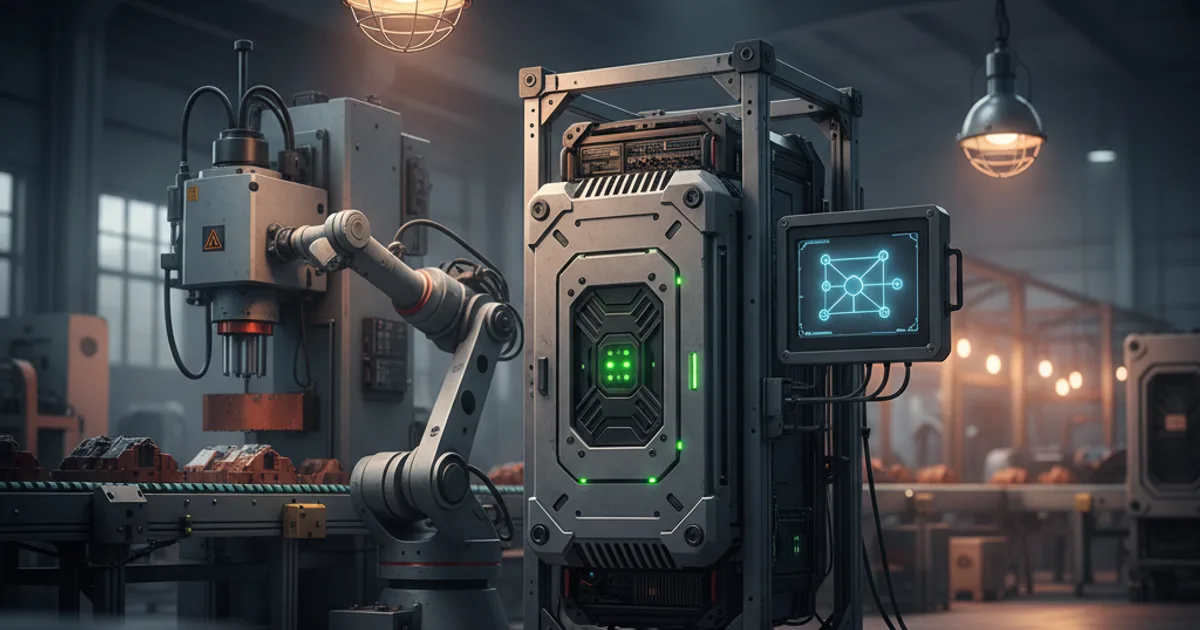
Industrial voice AI lives or dies on milliseconds. A cloud-only pipeline that works perfectly in an office can fail on a factory floor the moment a WAN link degrades, ambient noise spikes, or a safety command needs a sub-second response.
Why does a hybrid architecture outperform cloud-only pipelines in industrial voice AI?
A hybrid architecture outperforms cloud-only pipelines in industrial voice AI because it keeps time-critical tasks, such as wake-word detection, command recognition, and local safety decisions, at the edge while reserving the cloud for heavier reasoning and model retraining. Cloud-only voice pipelines commonly produce response latency between 600 and 1,700 milliseconds on stitched stacks, according to Telnyx performance benchmarks.
The problem with pure cloud architectures is structural, not incidental. Every audio packet travels from the factory floor to a regional cloud endpoint, through speech-to-text (ASR) processing, into the language model, back through text-to-speech (TTS), and then returns over the same WAN link. Each hop adds delay, and any one hop can fail. In environments with intermittent connectivity, that entire chain breaks.
A hybrid model collapses the fast path by colocating ASR, orchestration, and TTS either on-premise or regionally. Colocated stacks can reach endpoint latency under 200 milliseconds by eliminating the transit hops between those components. The cloud remains in the loop for tasks that genuinely benefit from centralized compute: training updated acoustic models on new industrial vocabulary, running complex multi-turn reasoning chains, or aggregating telemetry across distributed sites. The edge handles what needs to happen right now; the cloud handles what can wait.
For a manufacturer running machine-side voice commands across a noisy stamping facility with distributed buildings and a single WAN uplink, this division is not optional. It is the only architecture that stays online when the link degrades.
What latency thresholds determine high-availability user experiences in factory voice systems?
Voice AI systems must respond within 250 to 500 milliseconds for interactions to feel natural, and delays beyond 1,000 milliseconds degrade conversational flow enough to increase user abandonment. Factory-floor voice commands have stricter requirements: edge AI deployed directly on equipment networks can achieve sub-5-millisecond decision latency for local safety and control decisions.
The numbers break down into operational tiers. Responses under 500 milliseconds read as instant to operators. Responses between 800 and 1,200 milliseconds are acceptable for non-critical queries. Once latency crosses 1,300 milliseconds, users notice the delay. Above 2,000 milliseconds, the interaction feels broken, and in an industrial context that can mean an operator gives up on the voice interface entirely and reverts to manual input, eliminating the productivity gain the system was deployed to create.
Edge latency typically runs between 1 and 10 milliseconds at the compute layer, compared to 50 milliseconds to over 200 milliseconds for cloud compute alone. That gap, up to 90% reduction in processing delay according to Firecell, is what makes edge inference non-negotiable for machine-side commands. The SignalWire latency analysis notes that the practical ceiling for live conversational voice AI is roughly 1,300 milliseconds end-to-end: anything beyond that erodes the turn-taking rhythm that makes a voice agent feel like a real interaction rather than a query-response console.
For manufacturers, this means the architecture choice directly determines whether operators adopt the system. Latency is not a technical footnote; it is the primary adoption variable.
How does deploying voice AI at the edge protect proprietary industrial data and ensure compliance?
Edge voice AI improves data security by processing audio locally so sensitive operational data never leaves the facility perimeter during normal operation. Compliance benefits include strict data residency control, localized sovereignty, and privacy minimization: only redacted transcripts reach central systems rather than continuous raw audio streams.
For manufacturers handling proprietary process data, trade-secret operational parameters, or regulated information under frameworks like ITAR or HIPAA in adjacent healthcare manufacturing contexts, continuous audio streaming to a third-party cloud is a material risk. Local inference eliminates that exposure for real-time operations. The security architecture shifts from perimeter defense of a cloud endpoint to access control at the facility edge, which most industrial security teams already understand and manage.
This also matters for audit trails. When transcripts are sanitized before transmission, the central logging system never holds the raw audio that could expose sensitive verbal exchanges about production quality, supplier terms, or equipment performance. Access control tightens because the data never travels to a shared-tenancy environment in the first place.
From an AI infrastructure perspective, Agxntsix designs unified data layers that separate real-time edge telemetry from the CRM and pipeline data that lives in cloud systems, ensuring each data type moves only as far as its risk profile permits. The goal is a clean boundary between what the factory floor produces and what the enterprise layer needs, without collapsing them into a single undifferentiated stream.
What are the main operational challenges of managing voice AI models at the factory edge?
Managing voice AI at the factory edge requires heterogeneous hardware fleets, ruggedized compute for industrial conditions, and secure remote model management across potentially dozens of geographically distributed sites. Acoustic model drift, hardware lifecycle management, and network-segmented update pipelines are the three operational failure points most teams underestimate.
Hardware is the first constraint. Industrial edge nodes must tolerate vibration, temperature swings, dust, and electromagnetic interference that would degrade standard data-center equipment. Axiomtek's industrial AI deployment guidance identifies ruggedized hardware and secure remote management as baseline requirements, not optional enhancements. The second constraint is model currency. An acoustic model trained on general speech degrades in a high-noise stamping plant or a cold-storage facility with specific vocabulary. Keeping models current requires a reliable mechanism to push updates to edge nodes without requiring on-site IT intervention at every location.
The third constraint is coordination. A voice AI deployment across ten manufacturing plants means ten edge environments, each potentially running a slightly different hardware configuration, firmware version, or local vocabulary extension. Without a centralized model registry and a tested rollback path, a bad update can simultaneously degrade voice recognition across all sites.
By 2026, at least 50% of edge computing deployments are expected to involve machine learning, up from approximately 5% in 2022. That growth means the tooling for remote edge model management is maturing, but most industrial operators are still assembling these stacks from multiple vendors rather than deploying an integrated solution. The operational overhead of managing that fragmentation is significant and is often the reason manufacturers delay edge AI initiatives despite clear technical justification.
How can manufacturers optimize regional or edge latency for real-time machine-side commands?
Manufacturers reduce voice AI latency at the machine level by colocating ASR, the language model, and TTS on a single regional or on-premise network path, eliminating inter-service transit hops. Streaming ASR that begins transcription before the speaker finishes, combined with speculative TTS that pre-renders likely responses, can cut perceived latency by several hundred milliseconds.
The architectural principle is minimizing media hops. Every time an audio packet crosses a network boundary, it accumulates queuing delay, jitter, and potential packet loss. A cloud-stitched pipeline where ASR lives in one region, the LLM in another, and TTS in a third creates three boundary crossings before the response begins rendering. The Webex engineering team documented this problem in their AI agent latency work: collapsing those hops into a single colocated deployment is the single highest-leverage optimization available.
For machine-side commands specifically, a two-tier architecture works well in practice. A lightweight on-device model handles command recognition for a defined vocabulary: start, stop, report defect, call supervisor, confirm batch. That tier operates independently of WAN connectivity and responds in single-digit milliseconds. A second tier, either regional or cloud, handles open-ended queries, complex troubleshooting, or escalation routing where a longer response latency is acceptable because the operator has initiated a non-critical interaction.
This is the architecture Agxntsix recommends for manufacturers building high-availability voice AI: a fast local tier for commands, a connected tier for reasoning, and a clear handoff protocol between them so operators always get a response even when the uplink is degraded.
Edge AI versus Cloud-Only Voice Pipelines: Operational Comparison
| Feature | Agxntsix Hybrid Edge Approach | Cloud-Only Pipeline |
|---|---|---|
| Response latency (fast path) | Under 200 ms colocated; sub-5 ms on-device commands | 600 to 1,700 ms on stitched stacks |
| Connectivity dependency | Operates on degraded or offline WAN for core commands | Full failure on WAN outage |
| Data residency and compliance | Raw audio processed locally; only redacted transcripts leave site | Continuous audio stream to shared-tenancy cloud |
| Acoustic model customization | Per-facility vocabulary, updated via managed edge pipeline | Shared general model; customization limited by vendor |
| Hardware requirements | Ruggedized industrial compute with remote management | Standard cloud-connected endpoint sufficient |
| Model update and governance | Centralized registry with site-level rollback | Vendor-managed; operator has limited control |
| Implementation complexity | Higher upfront; requires AI infrastructure and edge orchestration | Lower upfront; operational risk accumulates over time |
Cloud-only pipelines earn their place in enterprise voice AI for back-office workflows, customer-facing call centers operating on reliable corporate networks, and any context where latency above 500 milliseconds is acceptable. The comparison above is not a verdict against cloud architectures broadly. It is a decision framework for the specific constraint set of industrial operations, where connectivity, noise, safety, and data sensitivity create requirements that a cloud-only pipeline cannot reliably meet.
IDC projects that 75% of large enterprises will rely on AI-infused processes by 2026 for asset efficiency, supply chains, and product quality. The manufacturers who reach that state first will be the ones who resolved the infrastructure question early rather than discovering mid-deployment that their voice AI architecture was built for an office, not a factory floor.
Sources
- Deploying Edge AI Across Industrial Environments - Axiomtek
- Voice AI agents compared on latency: performance benchmark
- What Is Edge AI & How Does It Help in Audio Classification - Ideas2IT
- What Causes Latency in Voice AI? How to Overcome It
- What Is Edge AI? How It Works, Benefits, and Challenges
- Engineering voice agents: Latency, quality, and scale - YouTube
- How New Edge Voice AI Makes Smart Devices More Accurate
- What 'Low Latency' Really Means in Voice AI | SignalWire