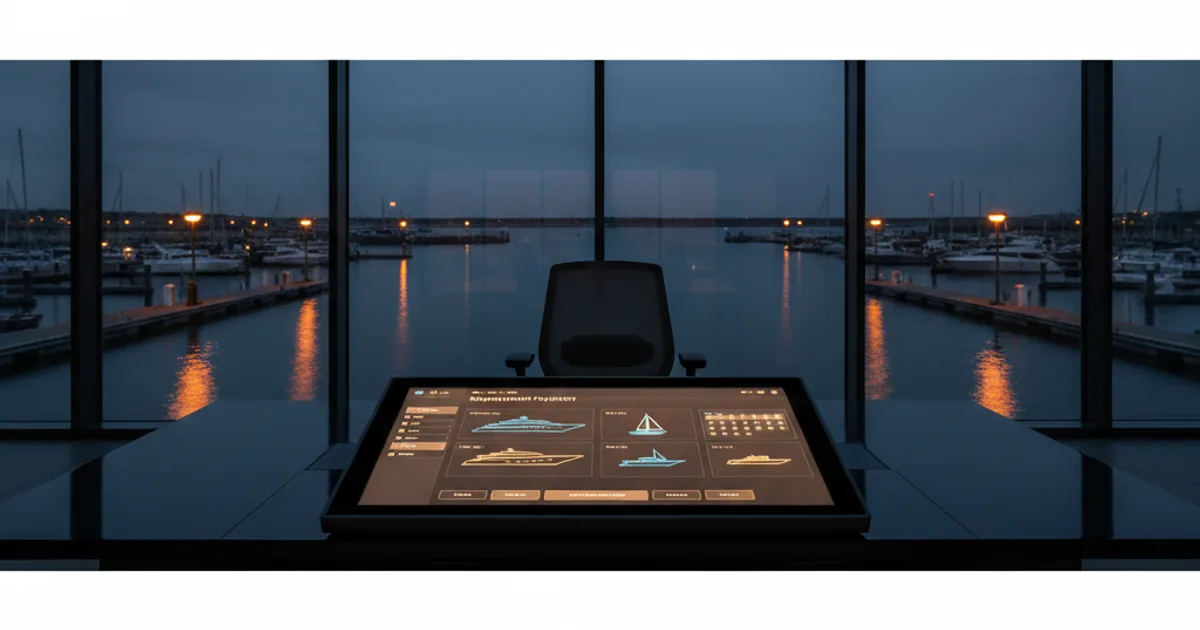
Yacht charter bookings are high-value, time-sensitive, and deeply consultative. A prospect ready to commit a six-figure charter fee will contact two or three brokerages and work with whoever responds first. This piece walks through how marine charter operators build automated inquiry pipelines that capture, qualify, and route high-value leads without sacrificing the concierge quality that defines the segment.
Why is speed to lead critical for multi-million-dollar yacht charter bookings?
Sales reps are 21 times more likely to qualify a lead when they contact a prospect within five minutes of inquiry compared to waiting 30 minutes. Across industries, fewer than 0.1% of inbound leads receive a response within that window, meaning the brokerage that closes it first wins by default.
In yacht charter, the stakes amplify this dynamic. A prospect comparing superyacht options across multiple brokerages is not filing a request and waiting a week. They have dates, they have a group, and they want a quote that afternoon. According to speed-to-lead benchmarks cited by LeanData and LeadAngel, 81.2% of companies that take longer than one hour to respond to an inbound lead lose those leads entirely. Nearly 47% of businesses fail to respond within 24 hours, and the average response time across tracked web leads sits at 17 hours. For a charter booking worth $200,000 or more, 17 hours is a full booking cycle wasted.
The operational correction is not hiring more brokers on night shifts. It is placing an automated response layer between the inquiry form and the broker's calendar so that every lead gets a substantive reply in under five minutes, at any hour, any day.
How does AI pre-qualification improve inbound lead quality for marine charter operators?
Conversational AI pre-qualification in yacht charters yields a lead quality rate of 40% to 60% meeting minimum booking criteria, compared to 15% to 20% for unqualified inbound web traffic. That gap closes the gap between inbound volume and broker time, so specialists handle prospects who are already qualified.
The mechanics are straightforward. When a prospect submits an inquiry through a website, travel platform, or digital campaign, an AI layer collects the parameters a broker actually needs: charter dates, embarkation port, group size, vessel class preference, approximate budget, and any itinerary notes. This is not a form with ten required fields; it is a structured conversation that guides the prospect while recording structured metadata. A dental group routing after-hours calls uses the same pattern: triage first, route second. Here, a charter operator qualifying inbound leads against minimum APA thresholds and vessel availability does the same thing, just for a much larger ticket size. The result is a quote-ready brief delivered to the broker before any human picks up the phone.
Operators building this layer should plan for deterministic fallbacks. If the AI cannot resolve a required parameter, it does not guess; it routes to a human or flags the record for callback. That validation logic is what separates a reliable pipeline from one that produces garbage briefs.
What does an automated workflow for yacht charter lead routing look like?
An automated yacht charter inquiry pipeline runs in five sequential stages: capture, normalize, qualify, route, and follow up. Each stage has deterministic rules, structured outputs, and a defined fallback so no lead falls out of the pipeline untracked.
The stages in order:
- Capture - Ingest inquiries from the operator's website, listing platforms, and paid campaigns into a single normalized queue. Strip duplicates, tag the acquisition source, and timestamp for speed-to-first-response tracking.
- Normalize - Convert free-text requests into structured fields: destination region, charter dates, vessel class, group size, and budget range. Flag missing required fields for resolution in the next stage.
- Qualify - Apply rules-based filters first (minimum booking value, date availability, geography) and then AI scoring to rank prospect intent. Records below threshold go to a nurture sequence; records above threshold move immediately.
- Route - Match the qualified brief to the appropriate specialist broker based on vessel type, region expertise, or language. Routing accuracy should be tracked as a first-pass metric and reviewed weekly.
- Follow up - Trigger an instant acknowledgment to the prospect within seconds of inquiry, then schedule automated follow-ups at defined intervals (one hour, 24 hours, 72 hours) until a broker has made contact. After-hours inquiries get the same instant response as business-hours inquiries.
This workflow maps directly to the infrastructure Agxntsix builds for high-touch service operators: a unified data layer that connects the intake channel to the CRM, automated qualification logic, and broker routing with full observability so nothing is lost between capture and conversation.
Which key performance metrics should luxury charter operations track?
Five metrics define pipeline health for a yacht charter operation: speed to first response, speed to calendar, qualified-to-booked rate, first-pass routing accuracy, and cost per booked week. Together they show where value is created and where it leaks.
Definitions and benchmarks for each:
| Metric | What It Measures | Target |
|---|---|---|
| Speed to first response | Minutes from inquiry submission to first substantive reply | Under 5 minutes |
| Speed to calendar | Hours from first response to broker consultation scheduled | Under 4 hours |
| Qualified-to-booked rate | Percentage of AI-qualified leads that convert to a signed charter agreement | Depends on segment, track trend |
| First-pass routing accuracy | Percentage of leads routed to the correct specialist without reassignment | Above 90% |
| Cost per booked week | Total pipeline and broker cost divided by charter weeks sold | Benchmark against prior period |
The global yacht charter market is estimated at USD 9 billion to USD 10 billion in 2025, with an average fleet booking rate of 35.85% weeks per year across a tracked sample of 7,660 vessels (Yacht-Rent, 2026). That means the average vessel sits unbooked for roughly 64% of the year. Operators who close their response window and improve routing accuracy can move that number without adding vessels or headcount.
How does lead-response automation preserve a premium brokerage experience?
Automation in luxury charter operations replaces the waiting period, not the broker. The AI layer handles the first five minutes so the human broker enters the conversation with full context, qualified intent, and a structured brief rather than a cold inquiry email.
The concierge experience depends on two things: responsiveness and expertise. Automation handles the first. A prospect who submits a superyacht inquiry at 11 PM and receives an intelligent, personalized acknowledgment within 30 seconds does not feel like they hit a contact form. They feel handled. When the broker calls the next morning with the prospect's dates, vessel preferences, and APA expectations already captured and confirmed, that interaction reads as high-touch because the broker spends the conversation on value, not data gathering.
This is the operational model Agxntsix applies to high-touch service verticals: Voice AI and intake automation create the instant response, while the AI infrastructure layer feeds the CRM so brokers have a complete record before first contact. The premium feel comes from the broker's expertise being applied where it actually matters.
What are the compliance and operational risks of slow response times in yacht charter booking?
The primary operational risk is direct: prospects book with a competitor. According to Harvard Business Review analysis cited by LeadAngel, companies are 7 times more likely to have a meaningful conversation with a decision maker when contacting them within the first hour versus waiting. A 17-hour average response time means most charter inquiries go stale before a broker ever reads them.
For operators using outbound follow-up sequences, particularly SMS or AI-generated voice calls to prospects who did not convert immediately, compliance requirements apply. The TCPA treats AI-generated voice as a robocall. Outbound AI calling requires prior express written consent for each number, and any sequence must suppress numbers on the National Do Not Call registry. Operators should confirm specific consent requirements with qualified legal counsel before deploying outbound AI calling. Agxntsix ties consent capture and DNC suppression to every outbound sequence it deploys, treating compliance as infrastructure rather than an afterthought.
On the data side, building an automated pipeline requires that inquiry data flow cleanly between intake forms, the AI qualification layer, and the CRM. Operators who have fragmented systems, where web forms feed one database, phone inquiries feed another, and broker notes live in a spreadsheet, cannot measure speed to response, cannot route reliably, and cannot identify where leads are leaking. Fixing that fragmentation is the first step. Automation built on top of broken data infrastructure produces faster broken results.
How should a yacht charter operation get started with inquiry automation?
Start with the response gap. Pull 90 days of inbound inquiries, note the timestamp of submission and the timestamp of first broker contact, and calculate average response time. That number is the baseline. In most operations without automation, it runs between 4 and 17 hours.
The build sequence from there:
- Unify intake channels into a single queue so web, email, phone, and platform inquiries are all visible in one place.
- Define the minimum qualifying parameters for a charter inquiry: dates, group size, destination region, and minimum budget signal.
- Build the AI qualification layer to collect those parameters and produce a structured brief.
- Connect the brief to the CRM and trigger an instant acknowledgment to the prospect.
- Set routing rules and measure first-pass accuracy weekly.
- Track the five core metrics from the first day so you have a clear before-and-after.
Operators in related high-value service verticals, from private aviation to financial services, use the same sequence. The physics of speed to lead apply regardless of ticket size; what changes is the complexity of the qualifying parameters and the stakes of each individual conversion.
Sources
- Lead Generation & Booking Automation for Yacht Charter ... - YouTube
- Yacht Charter & Packages AI Agent for Luxury Travel - Tars Chatbots
- Best Lead Routing Software for SaaS Companies - RevenueHero
- Yacht Charter Marketing Services | Qualified Leads
- Building a yacht charter AI: the hard work beyond model development
- Yacht Charter Statistics for yachts/boats in 2026
- Speed-to-Lead Benchmarks 2026: The Data Behind Why Most ...
- Top 10 Speed to Lead Stats Revenue Teams Should Know