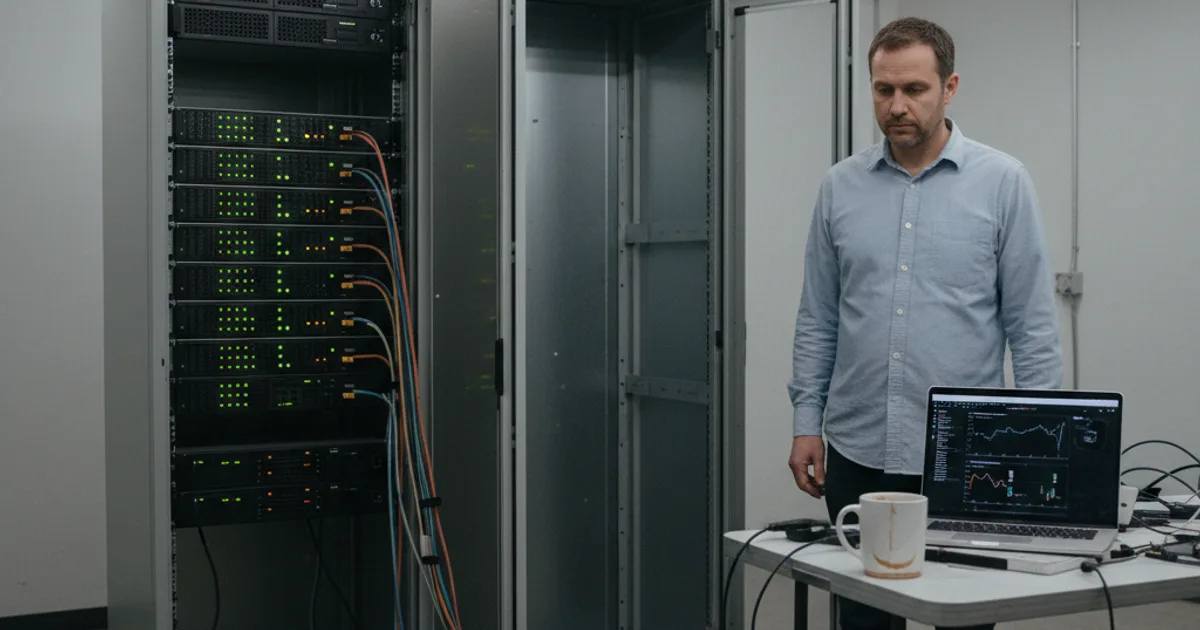
How to transition from AI pilot programs to full scale enterprise infrastructure deployment starts with fixing the talent gap, not the technology stack. Deloitte's 2026 State of AI in the Enterprise report found only 20% of organizations rate their talent readiness as high, and closing that gap requires a formal build, buy, and borrow talent strategy.
What Is the Talent Gap Holding Back Enterprise AI From Production?
The talent gap is a shortage of AI system engineers who can bridge research and production, not a lack of general AI literacy. An Iternal.ai analysis of the 2026 AI skills gap found that 90% of enterprises will face critical AI skills shortages by 2026.
As the OVI Blog put it in its analysis of Deloitte's research, enterprises face what it calls "The 20% Problem: Why Talent Readiness Is Enterprise AI's Critical Bottleneck." That framing matters because the shortfall is not generic AI fluency, it is the specific ability to run GPU clusters, low-latency pipelines, and model-serving infrastructure at scale. A.Team's 2026 research found 85% of tech leaders blame AI innovation delays directly on talent shortages, and Iternal.ai puts the resulting unrealized productivity at $5.5 trillion by 2026. A generic data scientist trained on model building rarely has the production engineering background this work requires.
How Many Enterprises Are Stuck in AI Pilots and Why?
Most enterprises remain stuck in the pilot stage rather than reaching production. Dan Cumberland Labs reports that 63% of enterprises stay stuck in pilots instead of scaling to full deployment, a gap driven primarily by unresolved talent and integration debt.
Deloitte's State of AI in the Enterprise report found 49% of organizations remain in early stages, either piloting or paused, and 25% of those cite a lack of internal AI talent as the direct cause. StackAI's 2026 adoption benchmarks show only 23% of organizations have scaled AI agents into production, against 62% still experimenting. A regional healthcare group running an AI intake pilot for six months with no production rollout is not an outlier, it is the median outcome once talent and data debt go unaddressed.
How Do I Diagnose Talent Readiness Before Scaling AI Infrastructure?
Diagnosing talent readiness means auditing which teams can operate production AI systems versus which only ran pilots. Deloitte's 2026 State of AI in the Enterprise report found only 20% of organizations rate their talent readiness as high, so most businesses start this diagnosis already behind.
A real diagnosis covers three layers: who can build and maintain the data pipelines feeding the model, who can operate the model in production under load, and who owns compliance sign-off. CIO.com reports 40% of CIOs name the lack of in-house talent as their top implementation challenge, and separately 82% of enterprises say they are not ready for AI infrastructure demands. For a call center evaluating private cloud clusters or GPU capacity, this audit should happen before any vendor contract is signed, not after.
How Do I Build a Unified Data Layer for Production AI?
Building a unified data layer means consolidating CRM, pipeline, and operational data into one LLM-readable structure before adding more AI use cases. Agxntsix's infrastructure research found that 71% of enterprises lack the data-network infrastructure required to scale AI, making this the first fix, not the last.
Deloitte found 46% of organizations name integration with existing systems as their primary deployment challenge, and 60% cite data quality and integration debt as a major barrier; separately, 77% of leaders rate their own data as average or worse. Operationally, this means one owner controls both the data layer and the application layer instead of splitting it across departments. A financial services firm consolidating loan, servicing, and call records into a unified data layer instead of stitching native CRM connectors typically moves from pilot to a working production workload months faster than one running parallel point integrations.
What Does a Build-Buy-Borrow Strategy for AI Talent Look Like?
A build-buy-borrow strategy combines internal upskilling, targeted external hiring, and temporary specialist partnerships instead of relying on any single source for AI talent. A.Team's research found 85% of tech leaders blame AI innovation delays on talent shortages, which is why businesses cannot hire their way out of the gap alone.
Deloitte found 48% of organizations design structured upskilling programs, 36% hire specialized talent, and 33% redesign career paths, but no single lever closes a 50% supply gap in AI talent on its own. The table below separates what each approach actually solves.
| Approach | What It Solves | Trade-off |
|---|---|---|
| Build | Internal teams learn business logic and data strategy over time | Slow; production infrastructure skills rarely develop fast enough alone |
| Buy | Fills senior AI system engineer roles for architecture and GPU deployment | Expensive and hard to source given a 50% AI talent supply gap |
| Borrow | External specialists handle initial deployment and low-latency pipeline work | Requires a hybrid handoff plan so internal teams retain ownership long term |
Agxntsix, for example, is a member of the Claude Partner Network, Anthropic's partner program for firms deploying Claude in production, and operates in the borrow layer: internal teams keep ownership of business logic and data strategy while external specialists manage GPU cluster architecture and initial low-latency pipeline deployment.
How Do I Redesign Roles and Career Pathways to Close the AI Talent Gap?
Redesigning roles means rewriting job descriptions and promotion criteria so advancement ties directly to measurable AI-driven outcomes, not tenure. Digit.fyi reports that 84% of enterprises have not rewired existing roles or workflows to meaningfully integrate AI, leaving structural change as the most overlooked lever.
One-time training events do not stick: Deloitte found 53% of organizations run broad workforce AI-fluency education and 36% mandate awareness training, but only 33% redesign career paths to reward effective AI use with real advancement. A logistics company that certifies dispatchers on AI-assisted routing but never changes how dispatchers get promoted will see the training decay within a quarter. Career-path redesign, not another workshop, is what makes the skill stick.
How Should Compliance Be Built Into Production AI Systems?
Compliance must be designed into AI systems before deployment, not audited afterward once systems run at scale. High-stakes decisions require human-in-the-loop workflows where a person reviews and validates AI outputs before action, since retrofitting governance into scaled systems multiplies both cost and risk.
Privacy, security, and access controls, covering entities like TCPA consent rules for outbound calling, HIPAA for healthcare communication, and internal Do Not Call suppression, belong in the operating procedure from day one. A voice AI deployment hardened against prompt injection at the design stage avoids the far more expensive rebuild that comes from adding guardrails after a system is already answering live calls. Businesses should confirm specific regulatory obligations with counsel; this is operational guidance on how systems should be built, not a legal determination.
What Is the Timeline for Scaling AI From Pilot to Production?
Scaling from pilot to production typically takes 6 to 8 months once a business commits to a formal operating model. Months 2 through 6 focus on building the unified data layer and running the first controlled production workload, with governance and system integration completed before broader rollout.
That window is where most projects stall: without a named owner for both data and application layers, the first controlled workload never leaves staging. A private aviation operator moving from a chatbot pilot to full call and booking automation typically spends the first month on data-layer audit, months two through six building the unified layer and shipping one production workload, and the remaining weeks on governance sign-off before expanding use cases. Agxntsix frames its own client engagements around a 60-day ROI commitment as a positioning standard, not a guaranteed outcome for every deployment.
What Are the Key Metrics to Track for Closing the Talent Gap?
Key metrics include the share of AI use cases running in production versus pilot, integration debt indicators, and realized ROI. StackAI's 2026 enterprise AI adoption research found only 23% of organizations have scaled AI agents to production, compared with 62% still experimenting, making that ratio the clearest readiness signal.
QuarterSmart's workforce capability analysis found only 21% of leaders report real AI ROI, and Deloitte separately found 46% name system integration as their primary blocker. Track these three together: production-to-pilot ratio, integration debt (open connectors and manual workarounds), and ROI realized against ROI projected. ROI-driven use case prioritization, not broad adoption, is what moves that 23% figure upward over time.
Sources
- Deloitte's enterprise AI infrastructure survey: A 2028 outlook
- The 20% Problem: Why Talent Readiness Is Enterprise AI's Critical Bottleneck | OVI Blog
- The State of AI in the Enterprise - 2026 AI report
- 84% of enterprises haven't rewired jobs for AI - Digit.fyi
- Only 21% of Leaders Report Real AI ROI — the Workforce ...
- Enterprises are scaling AI while their systems and workforce lag behind
- Enterprise adoption of AI is accelerating, but value isn't
- AI Skills Gap 2026: $5.5T Statistics & How to Close It