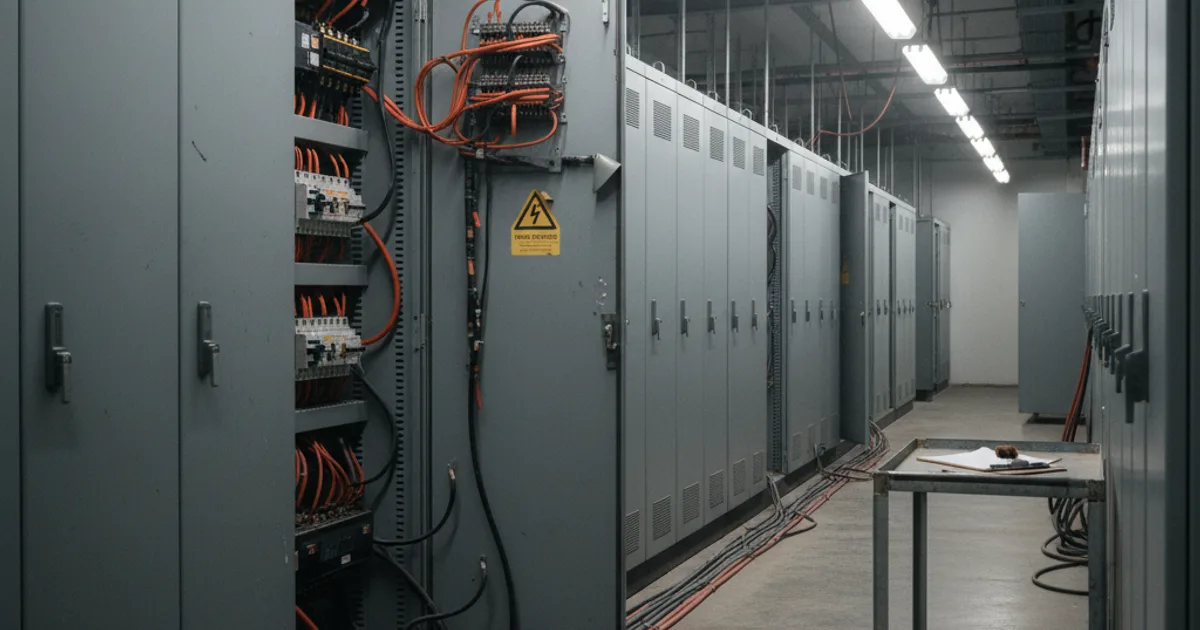
Why are states charging data centers extra for high load AI computing? Utilities add demand charges and transmission fees because concentrated GPU clusters draw far more power per rack than existing grids were built for, and U.S. data centers are projected to add $160 billion to grid costs over 15 years.
What are the hidden infrastructure costs of on-premises LLMs beyond GPU hardware?
On-premises LLM infrastructure costs 2.5 to 3 times the raw GPU investment once cooling, power delivery, colocation, and staffing get added to the ledger. Cooling systems alone consume 40 to 54% of total power draw in AI-optimized data centers, a load standard enterprise server rooms were never designed to carry.
A modest production-grade eight-GPU cluster carries a first-year investment of $600,000 to $800,000, with ongoing annual operating costs of $760,000 to $2,000,000, according to figures compiled in "Thinking of hosting your own enterprise LLM? It will cost you." Staffing alone runs $150,000 to $300,000 per megawatt of capacity, and DevOps and specialized engineering talent for a production deployment adds another $800,000 to $1,200,000 a year. Businesses evaluating this path should model total cost of ownership over three to five years, not against a single hardware invoice, which is the exact planning gap Agxntsix's AI Infrastructure practice is built to close before a client commits capital.
How do grid penalties and cooling fees impact the total cost of AI deployment?
Grid penalties and cooling fees add a direct surcharge on top of hardware and electricity costs for high-density AI facilities. Liquid cooling required for racks above 30 kilowatts adds a 7 to 10% premium over standard air-cooled facilities, and cooling infrastructure adds $1,000 to $2,000 per kilowatt annually in operating expense.
Data centers are projected to add $160 billion to US grid costs over the next 15 years, according to analysis referenced in the investigation "We Found the Hidden Cost of Data Centers. It's in Your Electric Bill," which found that buildout costs are increasingly passed through to residential ratepayers, with household electricity rates projected to spike by up to 70% in heavily affected regions. That is a second-order consequence most TCO models skip: the grid fee a state assesses on a facility today often becomes a rate case that reshapes electricity pricing for everyone connected to that grid within a few years, not just the operator who built the facility.
What is the break-even point for on-premises versus cloud AI in terms of token volume and GPU utilization?
On-premises AI infrastructure breaks even against cloud pricing only when sustained GPU utilization exceeds 60 to 80% and monthly token volume passes 50 million. Below that utilization threshold, idle GPU capacity erodes the savings, and organizations processing under 1 billion tokens per month rarely recover the upfront investment within three years.
A cost-benefit analysis of on-premise LLM deployment published on arXiv found that organizations processing more than 1 billion tokens per month could save $1.9 million, or 57%, over three years by moving on-premises, provided utilization stayed high. At scale, on-premises deployment reaches 60 to 70% of equivalent cloud cost, but that figure assumes disciplined capacity planning, not a server sitting idle overnight.
| Monthly Token Volume | GPU Utilization Needed | Likely Economics |
|---|---|---|
| Under 50 million | Any | Cloud API is cheaper |
| 50 million to 1 billion | 60 to 80% sustained | Break-even zone, model carefully |
| 1 billion or more | 80% or higher sustained | On-premises can save up to 57% over three years |
What are the compliance advantages and costs of hosting LLMs on-premises?
On-premises LLM hosting is justified primarily by strict data residency rules that keep sensitive data inside an internal network. Large enterprise deployments with multi-node, high-availability clusters carry $120,000 to $300,000 in upfront compliance documentation costs, on top of hardware and staffing.
This is where healthcare groups, financial services firms, and legal practices weigh the calculus differently than a retail brand. On-premises deployment offers predictable, fixed costs with no per-user fees, which simplifies compliance reporting compared to cloud APIs billed on variable, usage-based terms. Agxntsix, as a member of the Claude Partner Network, builds these architectures with Claude SDK and Agent SDK deployments that keep regulated data on infrastructure a client controls, while still routing lower-sensitivity or burst traffic to managed cloud capacity when volume spikes.
PUE and the Multiplier Effect on AI Data Center Operating Costs
Power Usage Effectiveness measures total facility power divided by IT equipment power, and it multiplies every dollar spent on compute. Standard data centers run a PUE of 1.2 to 1.5, but AI-dense facilities with liquid cooling and grid penalties routinely land above that range, pushing effective compute cost higher before a single GPU cycle runs.
AI-optimized facility construction costs $20 million or more per megawatt today, up from $7.7 million in 2020, according to figures cited in the Lenovo Press TCO report "On-Premise vs Cloud: Generative AI Total Cost of Ownership." Electricity itself represents 15 to 25% of total operating expense for a 1-megawatt AI slice, which runs $7.6 million to $15.9 million in total annual OpEx. A rising PUE does not show up as a line item labeled "penalty," it shows up quietly, inside every electricity and cooling invoice that follows.
What is the three-year total cost of ownership for an enterprise H100 GPU server?
A single eight-GPU H100 server costs $712,000 to $948,000 in total cost of ownership over three years, covering power, cooling, colocation, maintenance, and staffing. That three-year figure assumes continuous production use, and annual operating costs alone for a comparable eight-GPU cluster run $760,000 to $2,000,000.
| Deployment Element | 3-Year Cost Range |
|---|---|
| Single 8-GPU H100 server (TCO) | $712,000 to $948,000 |
| First-year investment, 8-GPU cluster | $600,000 to $800,000 |
| Annual operating cost, 8-GPU cluster | $760,000 to $2,000,000 |
| Renting an 8 to 16 H100 cluster monthly | $40,000 to $150,000 |
For comparison, renting an equivalent 8 to 16 H100 cluster costs $40,000 to $150,000 a month, a figure worth holding next to the ownership numbers before signing a multi-year colocation lease.
What are the power density and thermal limits of standard enterprise server rooms for AI?
Standard enterprise server rooms cannot support the 30 to 50 kilowatts per rack that modern GPU clusters require. Legacy server rooms built for traditional compute rarely reach a fraction of that density, which is why on-premises AI plans almost always need colocation or a purpose-built facility instead of an existing server closet.
A single GPU rack requires $25,000 to $35,000 annually for power and cooling alone, and building a dedicated AI data center runs $10 million to $50 million for smaller facilities, according to figures compiled in "Understanding the cost to setup an AI data center." Tech giants were projected to spend $375 billion on AI data center construction in 2025, a 67% increase from 2024, which is pulling grid capacity and construction labor away from smaller enterprise buildouts at the same time it raises the cost of every input those buildouts need.
How can businesses decide between a hybrid AI strategy and fully on-premises deployment?
A hybrid AI strategy that self-hosts high-volume routine inference while routing frontier-model and demand-spike workloads to cloud APIs minimizes both cost and infrastructure risk. This approach captures on-premises savings once volume passes 50 million tokens per month without carrying idle GPU capacity during slower periods.
A single GPU query uses 0.16 to 0.60 watt-hours for baseline inference, but extended reasoning queries spike to 4 to 40 watt-hours, a variance most cloud contracts absorb automatically but that an on-premises operator has to provision hardware for in advance. Agxntsix's embedded consulting practice builds this hybrid layer directly into a client's existing CRM and data infrastructure rather than as a separate system, and treats the decision as a 3 to 5 year capacity plan under its 60-day ROI positioning for infrastructure engagements, not a one-time hardware purchase.
Sources
Sources
- The Hidden Infrastructure Cost of Running Local LLMs vs Cloud APIs
- Thinking of hosting your own enterprise LLM? It will cost you.
- On-Premise vs Cloud: Generative AI Total Cost of Ownership (2026 Edition)
- On-Premise AI Cost & TCO: The Real 2026 Breakdown
- Understanding the Total Cost of Inferencing Large Language Models
- A Cost-Benefit Analysis of On-Premise Large Language Model Deployment
- Cost of Running Local LLM: Real Numbers & Break-Even Guide 2026
- AI infrastructure TCO: Enterprise Guide