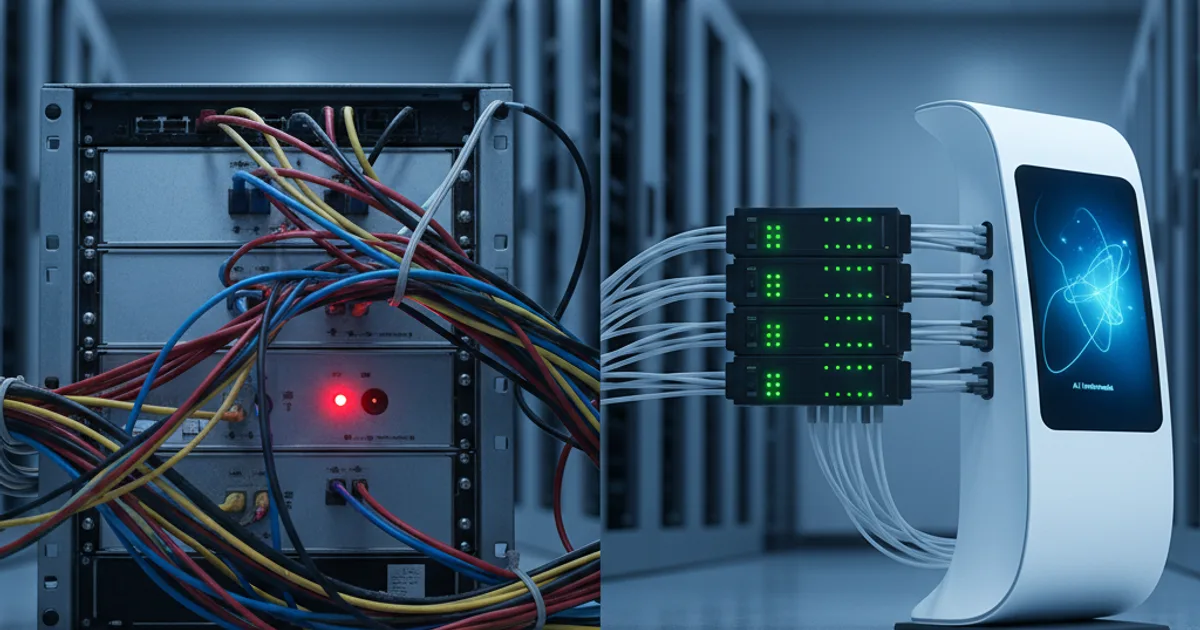
CRM platforms were built to store records and support manual workflows. Outbound voice AI needs something different: low-latency, event-driven data access at conversational speed. The mismatch between those two realities is where most enterprise voice AI deployments quietly fail.
Why does a native CRM schema inhibit the real-time execution of outbound voice AI?
A native CRM schema stores records for human retrieval, not for sub-second machine queries. Its field structures, object relationships, and API rate limits are designed around manual processes, not event-driven voice agents that need to read contact state, intent history, and consent flags in under 500 milliseconds. Direct API calls into a legacy CRM introduce sync delays and exposure to unannounced schema changes.
The practical consequence is that every call the voice agent initiates carries a hidden tax: the time spent querying a CRM that was never designed for real-time execution. According to Gladia's tactical guide to integrating voice AI with legacy CRM systems, direct integrations introduce risks including undocumented API behaviors and schema modifications that vendors push without notice. A field that holds opt-out status today may be renamed or relocated in the next CRM release, and if the voice agent has no isolation layer, every call fails silently until someone traces the break.
About 17% of corporate CRM users identify lack of software integrations as a primary structural challenge, per Databar.ai's analysis of enterprise CRM adoption. That figure understates the problem for voice AI, because the integration requirement here is not just connectivity but low-latency, schema-stable connectivity.
How does sub-second execution latency affect customer engagement and call outcomes?
Voice response latency above 500 to 700 milliseconds produces unnatural conversational pauses that erode customer trust and increase hang-up rates. At that threshold, the interaction stops feeling like a call and starts feeling like a broken phone line. A voice agent querying a slow CRM API in the middle of a greeting can cross that threshold on the first exchange.
The operational cost compounds. Deploying AI at call-center scale can reduce interaction costs from $4.60 down to $1.45 per engagement, according to Azumo's 2026 AI customer service statistics. But that savings evaporates if latency drives early hang-ups and the call never reaches its purpose. Speed is not a comfort feature; it is the mechanism by which a voice agent either earns or loses the next 90 seconds of the call. Roughly 79% of contact centers already use voice chatbots, per the same source, so competitive differentiation is shifting from whether you have voice AI to whether yours performs well enough to hold the line.
Which architecture patterns best decouple voice agents from legacy CRM databases?
An intermediate unified data layer, sometimes called an operational cache or read replica, isolates the voice agent from direct CRM dependency. The agent reads from the cache, the cache syncs with the CRM on a controlled schedule, and schema changes in the CRM require only a remapping step in the middleware rather than emergency surgery on the voice agent itself.
The Gladia guide recommends a cache window of 5 to 10 seconds for stable read operations, which eliminates repetitive CRM calls during an active conversation without introducing stale data risk for fields like consent status. GoodCall's architecture breakdown confirms that the canonical pattern maps CRM fields to a predictable intermediate schema covering contacts, intents, and consent states, so the voice agent always reads from a known structure regardless of what the upstream CRM looks like.
The key design rule: write-backs to the CRM should never block the conversation. Post-call webhooks handle pipeline updates asynchronously after the call ends. The voice thread and the CRM sync thread are separate processes. Mixing them is the single most common architecture error in early-stage voice AI deployments. Read more about how AI infrastructure enables this kind of clean separation in practice.
How do pipeline sync failures impact downstream automation workflows?
Pipeline failures do not only delay data; they break the automation chains that depend on that data arriving in sequence. Data pipeline failures occur at an average rate of 4.7 incidents per month per organization, requiring nearly 13 hours to resolve each event, according to Striim's data synchronization guide. Roughly 97% of senior data leaders report that pipeline interruptions have delayed critical AI or analytics timelines.
For outbound voice AI, the consequences are concrete. A failed sync means the agent dials a contact whose opt-out was recorded three hours ago but never propagated. It means a follow-up call goes out before a prior call's disposition has written back, so the agent opens with the wrong intent context. It means a deal that moved to closed-won in the CRM still appears as open in the voice campaign queue, generating a call that damages the relationship.
The remediation pattern is pipeline observability: instrumented sync jobs with alerting on failure, replay queues for failed write-backs, and idempotency keys on all webhook payloads so retries do not create duplicate records. These are not advanced engineering concerns; they are baseline requirements for any organization running voice AI at scale.
What are the compliance and access security requirements for voice AI middleware?
Voice AI middleware that touches contact records, consent states, and call recordings must satisfy TCPA consent traceability, DNC registry suppression, and, where healthcare data is involved, HIPAA's minimum-necessary and audit-trail requirements. The middleware is not a passive pipe; it is a data processor with compliance obligations.
The FCC's rules on AI-generated voice treat every outbound AI call as a robocall, requiring prior express written consent per number. That consent record must be queryable at call initiation time, which means it belongs in the unified data layer with sub-second read performance, not buried in a CRM contact note field. Access controls on the middleware itself matter too: role-based permissions, encrypted transit, and logged access for any system that touches consent or call recording data. Agxntsix ties consent capture and DNC suppression directly to every outbound campaign it deploys, including audit-ready logging for regulated industries.
How do I build a canonical schema that a voice agent can actually use?
A canonical schema for voice AI defines the minimum fields required for the agent to make a decision: contact identifier, phone number, consent status, prior interaction summary, intent stage, and any suppression flags. Every CRM field maps to one of those canonical fields, and the mapping is documented. If a CRM field cannot map cleanly, it is either transformed or excluded.
This is not a one-time migration. CRM vendors update their schemas, sales teams add custom fields, and compliance requirements shift. The canonical schema needs version control and a change management process. A dental group routing after-hours recall calls, for example, needs consent fields that satisfy both TCPA and HIPAA minimum-necessary standards; a single undocumented CRM field rename can break both simultaneously. Treat the schema mapping as a living artifact, reviewed at every CRM update cycle.
How should post-call data flow back into the CRM pipeline without blocking live calls?
Post-call write-back should run entirely on an asynchronous webhook queue, not on a synchronous API call that the conversation thread waits for. The call ends, the voice platform emits a webhook payload containing disposition, transcript summary, intent update, and any next-action flags, and a queue worker processes that payload against the CRM in the background.
This pattern protects call performance and gives the write-back process room to handle CRM API throttling gracefully. If the CRM is slow or temporarily unavailable, the queue holds the payload and retries; the next outbound call is unaffected. Telnyx's 2026 outbound voice AI resource and Decagon's glossary both confirm that asynchronous post-call processing is the standard pattern for production voice AI deployments. A charter operator qualifying inbound leads, for instance, can have a voice agent handle 40 simultaneous calls while a separate write-back queue updates pipeline stage and contact notes in the background, none of which touches the live call threads. A unified data layer built for AI operations makes this queue architecture straightforward to implement.
What data quality baseline is required before deploying outbound voice AI?
Outbound voice AI requires clean phone numbers, verified consent records, and accurate suppression lists as the hard minimum before a single call goes out. Poor baseline data quality is one of the core barriers to enterprise-scale generative AI deployment in CRM environments, per Salesforce's analysis of AI CRM adoption challenges. The voice agent cannot compensate for a contact list with stale numbers, missing opt-out flags, or duplicate records.
The pre-deployment audit should cover: deduplication of contact records, validation of phone number format and reachability, confirmation of consent timestamps and source documentation, and a full DNC scrub against both the national registry and internal suppression lists. AI-driven customer service solutions resolve inquiries in an average of 32 minutes versus up to 36 hours for manual setups, according to Azumo's data, but that performance gap assumes the underlying data is trustworthy. Start with a data audit, not a deployment.
Sources
- A tactical guide to integrating voice AI with legacy CRM systems
- What is outbound voice AI? | Decagon glossary
- Outbound Voice AI: 2026 Insights - Telnyx
- Voice AI Architecture Explained: How Calls Turn Into CRM Data
- The impact of AI-enabled CRM systems on organizational ... - PMC
- Data Synchronization: A Guide for AI-Ready Enterprises - Striim
- AI-powered next best experience for customer retention - McKinsey
- Data Pipeline for AI vs. Federated Query: Which Approach Wins?