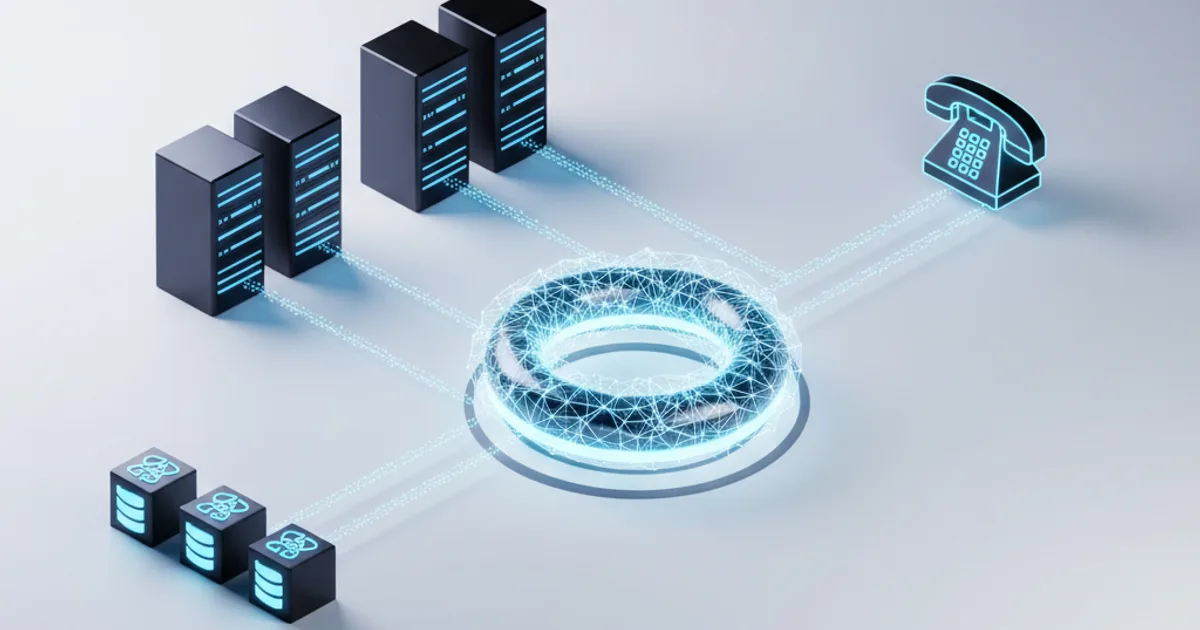
Dedicated unified data layers outperform native CRM connectors for enterprise voice AI by delivering AI accuracy rates of 94% to 99% versus 10% to 31% for ungrounded or connector-dependent agents. The difference comes down to where filtering happens, how governance is enforced, and whether the architecture can sustain real-time sync across every system of record without creating operational database bottlenecks.
Why Do Native CRM Connectors Suffer From the Pull-All Client-Side Filtering Problem?
Native CRM connectors perform filtering on the client side, meaning the integration pulls entire datasets from the source system before applying any logic to narrow the result. This bloats the AI context window, drives up token costs per call, and raises the probability of the model reasoning over stale or irrelevant records.
The practical consequence for a voice AI deployment is compounding. A connector pulling a full contact list to identify one inbound caller wastes compute budget and introduces latency the caller notices. According to StackOne's analysis of unified API limitations, client-side filtering is one of the core reasons API-based agent integrations break at scale, because the volume of data flowing through the connector grows with the dataset, not with the actual query complexity. Point-to-point API connections also encounter hard walls from API rate limits, schema mismatches, and one-way sync failures, each of which can silently degrade AI agent behavior without triggering an obvious error. For a voice AI system handling thousands of daily interactions, those silent failures accumulate into measurable accuracy losses.
How Do Dedicated Unified Data Layers Prevent LLM Hallucinations and Scale Accuracy?
Dedicated unified data layers prevent LLM hallucinations by performing server-side filtering before data reaches the model, supplying only the records relevant to the current query. Properly grounded AI operating on a unified context layer achieves accuracy rates of 94% to 99%, compared to 10% to 31% for ungrounded agents, according to available enterprise AI infrastructure research.
The mechanism is the semantic layer. As Atlan's analysis of enterprise AI context layers notes, a dedicated semantic layer supplies "critical business definitions, lineage, quality signals, and governance policies" that stop AI agents from reasoning over raw schemas. Raw schemas expose column names, join logic, and field types that carry no business meaning; the semantic layer translates those into governed definitions the model can use safely. A dental group routing after-hours calls, for example, needs the voice AI to distinguish an active patient record from an archived one without ever surfacing protected health information to the wrong context. Server-side filtering enforced by the semantic layer makes that distinction before the model sees any data. The result is a system that Scale AI describes as making enterprise data "agent-ready" rather than merely accessible.
What Are the Operational Database Bottlenecks Associated with Native Connectors?
Native connectors create operational database bottlenecks by triggering full-record transfers every sync cycle rather than capturing only the records that changed. This places sustained read load on production databases and creates latency spikes that degrade both the source system and the AI agent depending on it.
Change Data Capture (CDC), the mechanism at the core of a dedicated unified data layer, resolves this by tracking only the delta between states. Stacksync's guide to syncing CRM records across multiple business systems identifies CDC as the architectural choice that reduces operational database load by confining sync activity to updated records. The complementary pattern is a Pub/Sub (Publisher/Subscriber) architecture, which pushes updates to all connected systems the moment a change is committed, eliminating polling delays. A private aviation operator managing fleet availability and client itineraries across a CRM, a scheduling system, and a billing platform cannot afford a 15-minute polling window when a voice AI agent is confirming a charter in real time. CDC plus Pub/Sub closes that window to near-zero. The Stacksync research on real-time bidirectional CRM sync confirms that architectures without these patterns consistently produce stale-data errors and agent failures under production load.
How Do Unified Data Layers Preserve Provider-Specific Capabilities and Custom Fields?
Unified data layers preserve provider-specific capabilities by maintaining a passthrough path for proprietary fields and permissions rather than forcing everything into a normalized common schema. Normalization is the hidden cost of many unified API products: it simplifies integration but destroys the granularity that enterprise workflows depend on.
StackOne's research on unified API limitations documents exactly this failure mode: unified APIs that normalize data into a single schema "strip away" complex document properties and granular permissions that individual CRM providers expose. A financial services firm running Salesforce Financial Services Cloud with custom object hierarchies, or a healthcare group using Epic integrations with HL7-mapped fields, cannot afford to lose that structure in translation. A dedicated unified data layer, built as an intelligence fabric rather than a normalizing API wrapper, connects to every system of record simultaneously and maintains each provider's native schema in its original form while still presenting a governed access surface to the AI agent. Pacific Data Integrators' analysis of enterprise AI fabrics notes that this architecture creates "a living representation of the business without forcing manual data copying into new repositories," which means the CRM's native capabilities remain intact and the AI agent reads them through a governed lens rather than a flattened schema.
What Is the Strategic Impact of a Data Fabric on Voice AI Governance and Compliance?
A data fabric enforces governance policies at the infrastructure layer, ensuring voice AI agents operate within defined authority rules before any query reaches a production system. This is the compliance control point for regulated industries: it is where HIPAA data-handling boundaries, TCPA consent flags, and role-based access controls live as enforceable policies, not documentation.
The exposure without this layer is concrete. According to research indexed by SSRN on connecting enterprise systems through unified data layers, enterprises must map database fields, trace data relationships, and codify authority rules to manage conflicting updates between systems before deploying voice AI. Without that pre-work encoded into the fabric, the AI agent becomes an ungoverned actor that can pull data it should not see and write records it has no authority to update. Deloitte's analysis of CRM modernization challenges identifies this lack of centralized governance as one of the most common failure modes in large-scale AI deployments. The Gartner-adjacent research in this domain supports the same conclusion: 83% of organizations report AI agent adoption, but only 54% have a centralized governance framework in place, leaving nearly half of active deployments running without enforceable data policy. For Agxntsix clients in healthcare, financial services, and legal services, the data fabric is where compliance becomes operational rather than aspirational. AI infrastructure for regulated industries and HIPAA-compliant voice AI deployments require this foundation before any agent goes live.
How Do Unified Integration Architectures Drive Growth and Speed Up AI Agent Deployments?
Unified integration architectures accelerate AI agent deployments by eliminating the point-to-point connector sprawl that slows implementation, and by giving agents a single, governed access surface across all systems of record. A unified data model enables voice AI agents to handle 73% more complex queries autonomously, according to enterprise AI infrastructure benchmarks.
The growth signal is equally direct. Companies using AI-powered CRMs with strong data unification are 86% more likely to exceed their sales goals, and CRM automation reduces sales cycles by 8% to 14%, according to available CRM analytics research. A charter operator qualifying inbound leads through a voice AI agent connected to a unified data layer can route a caller, verify availability, pull pricing rules, and log the interaction back to the CRM in a single call flow, with no human in the loop for the qualification step. The same architecture applied to an outbound pipeline delivers consistent contact quality because the agent is drawing from a single governed source of truth rather than reconciling conflicting records from three separate connectors. Pacific Data Integrators' research on AI fabrics documents a reduction in pipeline duplication of 40% or more when a centralized intelligence fabric replaces point-to-point integration. For teams evaluating build-versus-buy decisions on AI infrastructure, that duplication reduction translates directly into lower maintenance burden and faster iteration when the underlying CRM or data model changes. Voice AI implementation for enterprise operations depends on this architectural foundation being in place before the agent layer is added.
Architectural Decision Matrix: Unified Data Layer vs. Native CRM Connector
| Feature | Dedicated Unified Data Layer | Native CRM Connector |
|---|---|---|
| Filtering approach | Server-side, pre-query | Client-side, post-pull |
| AI accuracy range | 94% to 99% | 10% to 31% |
| Sync mechanism | CDC plus Pub/Sub, delta-only | Full-record polling or webhook |
| Provider-specific fields | Preserved via passthrough | Often stripped by normalization |
| Governance enforcement | Semantic layer with authority rules | Connector-level, ad hoc |
| Context window efficiency | High, only relevant records passed | Low, full dataset pulled first |
| Compliance readiness | HIPAA, TCPA, role-based access at infrastructure layer | Dependent on per-connector configuration |
Sources
- 7 Unified API Limitations for AI Agent Integration - StackOne
- 5 Common CRM Integration Problems and Their Solutions
- Enterprise AI Interoperability with AI Gateways - Truefoundry
- The Step-by-Step Guide to Sync CRM Records Across Multiple Business Systems - Stacksync
- What is a unified API? | Nango Blog
- 5 Common CRM Implementation Challenges and Solutions
- Do Enterprises Need a Context Layer Between Data and AI? - Atlan
- CRM Data Integration: Approaches, Challenges, and Solutions