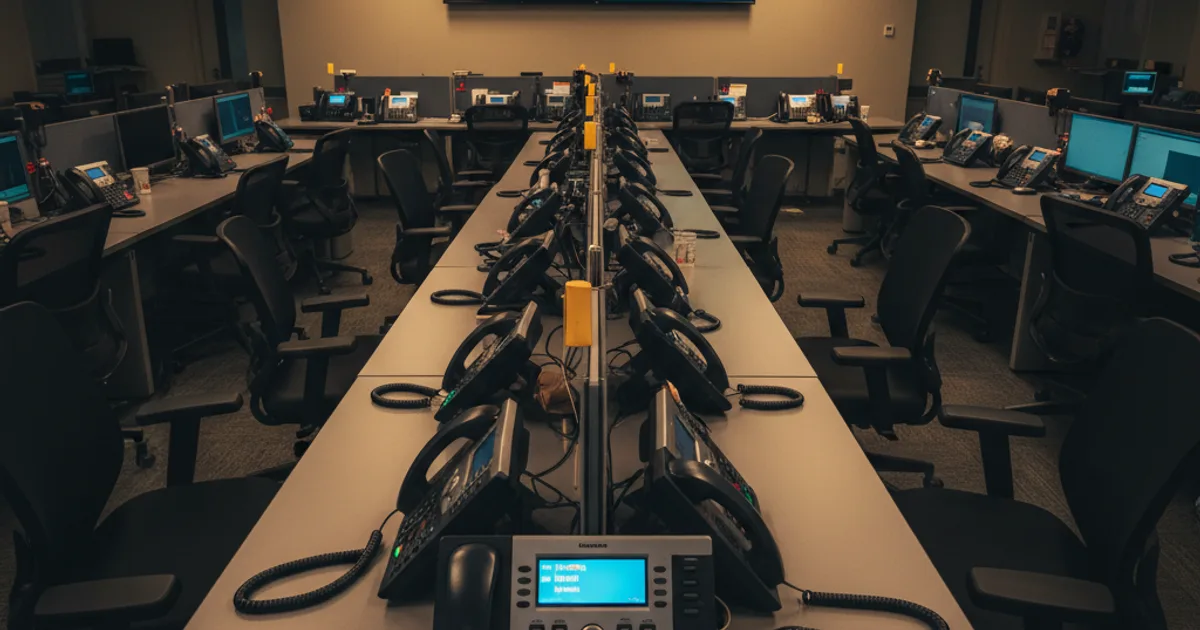
Promotional campaigns generate demand spikes by design. The problem is that most business phone operations are sized for average volume, not peak volume, and the gap between those two numbers shows up directly on the revenue line.
How do you calculate the financial cost of missed inbound calls during a promotional campaign?
The margin cost of a missed promotional call equals the number of missed calls multiplied by the contact-to-sale conversion rate and the gross margin per sale. A business that misses 30 calls per day during a two-week campaign at a 20 percent conversion rate and a 500-dollar gross margin per sale is leaving 21,000 dollars on the table from that window alone. The formula is not theoretical; every input is measurable from your CRM and phone system.
The calculation matters because promotional periods compress opportunity into a short window. A missed call on a Tuesday in November carries the same math as any other day, but a missed call on the Friday of a Black Friday campaign, or on the first morning after a radio spot airs, represents a customer who responded to money you already spent acquiring them. The incremental acquisition cost is already sunk. The only variable left is whether you captured the conversation.
According to research cited by PCN Answers and Nextiva, small and mid-sized businesses miss between 25 percent and 60 percent of inbound calls during peak periods, and 85 percent of callers who reach voicemail do not call back. At those rates, a campaign that generates 200 inbound calls might yield fewer than 70 completed conversations, before conversion math even begins.
For multi-location operators, the exposure compounds. Revmo AI reports annual revenue losses ranging from 52,000 dollars to 292,000 dollars per location from missed calls across all periods, not just campaigns. A targeted promotional push with unmanaged inbound capacity accelerates that loss into days instead of months. The full methodology for steady-state after-hours missed-call math is covered in Calculating the Margin on After-Hours Lead Capture: The Cold Math of Automated Inbound Response.
What are the industry-specific benchmarks for the financial value of a missed call?
The dollar value of a missed call varies by vertical and ranges from approximately 145 dollars in online retail to over 2,000 dollars for specialized medical and dental appointments. Home services and hotels cluster in the 300 to 550 dollar range per missed call. These benchmarks, drawn from Voksha and OnceHub research, set the floor for any ROI model on call automation.
The practical implication is that the same staffing gap carries wildly different financial consequences depending on what your business sells. A missed call at a dental group scheduling a new-patient exam carries a different margin exposure than a missed call at a hotel booking a weekend room. Applying the correct vertical benchmark is step one in building a credible business case.
Industry benchmarks by vertical:
| Vertical | Estimated value per missed call |
|---|---|
| Specialized medical / dental | 2,000 dollars or more |
| Hotels / hospitality | 450 to 550 dollars |
| Professional services | 300 to 700 dollars |
| Home services | 300 to 400 dollars |
| Online retail | 145 to 155 dollars |
For healthcare and legal verticals, these figures also carry a lifetime value multiplier. A new dental patient who books from a promotional campaign is not a single transaction; they are a relationship. Missing that first call ends the relationship before it begins.
How does customer support and call center automation defend business margins?
Call center automation reduces operational costs by up to 30 percent and can deliver a 210 percent return on investment over three years with a payback period under six months, according to Teneo.ai and Typedef research. Voice AI handles inbound volume continuously without per-call staffing overhead, which means a promotional spike does not require emergency headcount.
The structural advantage of voice AI during a campaign is not just cost reduction. It is capacity decoupling: the number of calls your business can handle stops being constrained by the number of agents available at that moment. An AI voice layer answers every call at the first ring, qualifies the caller, collects intake information, and routes to a human only when the conversation requires it.
For high-ticket verticals running promotional campaigns, an illustrative scenario is a private aviation or yacht charter operator that sends an email campaign on a Tuesday morning. Inbound calls spike within two hours. Without automated inbound handling, three to five of those calls go to voicemail before the sales team clears the queue. At 2,000 dollars or more per missed qualified inquiry, that is a five-figure loss from a single email send. Voice AI absorbs the spike without a staffing scramble, and the Genesys research on conversational AI transformation also points to a 14 percent agent productivity lift when AI assistance handles routine inquiry volume, freeing agents for the conversations that actually need them.
Agxntsix deploys enterprise voice AI for exactly this scenario: 24/7 inbound coverage that scales to campaign volume without requiring the business to predict or staff for the peak.
Why is network bandwidth and architecture critical for conversational AI performance during traffic spikes?
Underprovisioned network infrastructure creates latency that degrades conversational AI performance and increases call abandonment, even when the AI application itself is correctly configured. FDC Servers' guidance on scaling bandwidth for AI applications notes that minimal increases in network latency can disrupt AI performance at the application layer. The network is not a passive pipe; it is a constraint on realized ROI.
For businesses running promotional campaigns with voice AI handling inbound calls, the architecture decision is whether to overprovision static bandwidth or build for burst capacity. Static overprovisioning means paying for unused capacity during non-campaign periods. Burst-capacity design, where bandwidth scales on demand during spike windows, lets businesses absorb a promotional surge without permanent infrastructure cost. The Expereo bandwidth requirements research recommends unified observability across compute, network, and storage so that a degradation in one layer surfaces before it affects call quality or AI response time.
Practically, this means that a business deploying voice AI for a high-volume promotional period should confirm with its infrastructure provider that the underlying network is provisioned for the expected call concurrency, not just average daily volume. A missed-call problem caused by a busy signal is visible. A call-quality problem caused by a latency spike during peak volume is harder to diagnose but equally costly.
What compliance and governance considerations are required when scaling call center AI?
Scaling AI call handling during a promotional campaign requires the same compliance posture as steady-state operations, applied to higher call volume and potentially new audience segments reached by the campaign. For outbound components of a campaign, TCPA consent requirements and National Do Not Call registry suppression are non-negotiable. For healthcare operators, HIPAA governs how patient information captured during an AI-handled call is stored and routed.
The risk is not limited to regulatory penalties. Governance failures on data captured during a campaign spike, such as intake information collected by AI that is not properly logged into the CRM, create decisions made on incomplete data. A promotional campaign that generates 300 AI-handled inbound calls but logs only 200 of them in the pipeline creates a reporting gap that distorts conversion analysis and lead follow-up. Agxntsix's AI infrastructure practice addresses this directly by building unified data layers that connect voice AI output to CRM and pipeline records in real time, so every captured conversation becomes a structured record regardless of volume.
Operators running campaigns in regulated verticals should confirm consent capture and data routing with qualified counsel before launch. The operational setup can be engineered to support compliance; the legal confirmation of adequacy is a separate step.
What is the real payback timeline for call automation deployed around campaigns?
Call automation investments in the customer support context return a 210 percent ROI over three years with payback in under six months, per Typedef benchmarks. For promotional-campaign-specific deployments, the payback window compresses further because the revenue exposure is concentrated into days, not quarters.
The marketing automation benchmark from Oracle is also instructive: 44 percent of adopters see a return within six months, and the category returns 5.44 dollars per dollar spent over three years. These figures apply to automation broadly, but the underlying logic maps directly to inbound call automation: the investment is largely fixed, the volume benefit scales with campaign frequency, and every additional promotional period the system handles reduces the effective cost per captured call.
For a business running four promotional campaigns per year, the math on automation compounds. Each campaign that would have leaked 25,000 to 75,000 dollars in missed-call revenue, a range cited in PCN Answers' missed call revenue study for businesses missing 30 calls per month, instead captures that opportunity. The automation cost does not increase with each campaign. The protection does.
Sources
- 5 Key Numbers for ROI of Call Center Automation - Teneo.Ai
- How to Scale Bandwidth for AI Applications - FDC Servers
- Unlocking ROI: How conversational AI transforms contact centers
- Customer Support AI ROI Benchmarks - Typedef
- AI & the Bandwidth Reckoning Infographic | Expereo
- The True Cost of Missed Calls | Voksha
- The Secret Hidden Cost of Missed Calls for Small Businesses
- The Hidden Cost of Missed Calls in Multi-Location Businesses