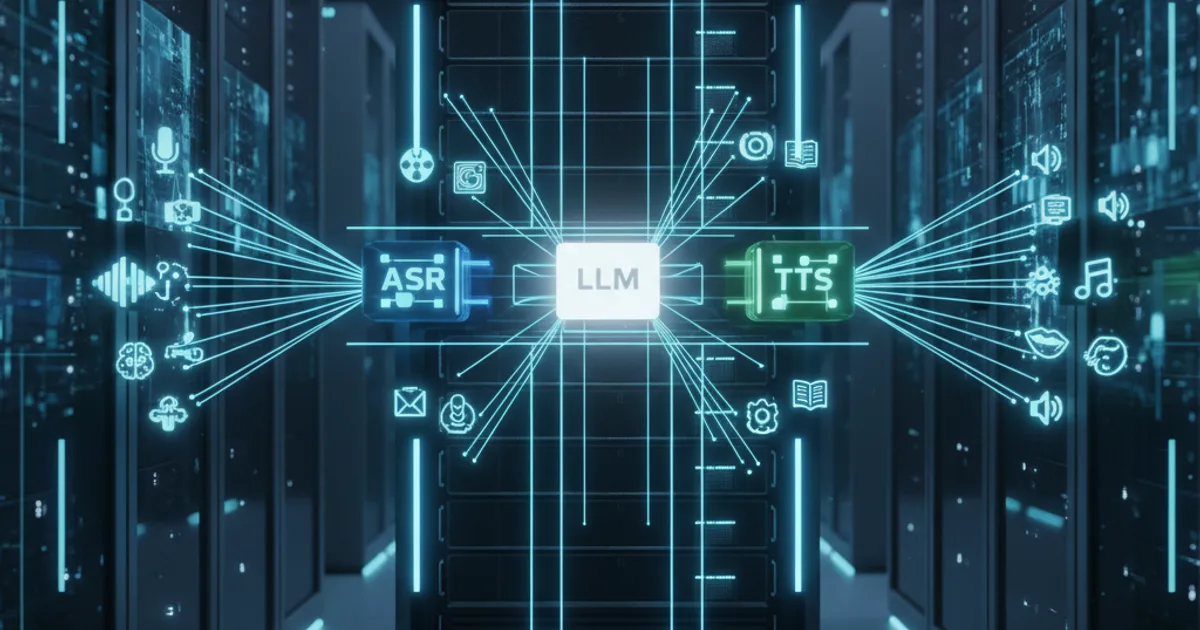
How to reduce conversational voice AI latency is the central engineering and business problem in enterprise voice AI deployment. The answer is a combination of parallel tool execution, geographic co-location of pipeline components, conversational streaming, and model right-sizing. Production voice agents today run at 1.4 to 1.7 seconds of end-to-end latency, roughly 5 to 8 times slower than natural human turn-taking, and that gap costs real revenue.
Why does standard voice AI latency fail the expectations of human listeners?
The human brain expects a conversational response within approximately 200 milliseconds, and interactions begin to feel unnatural above 300 milliseconds. The industry median production latency for voice agents sits at 1.4 to 1.7 seconds, according to benchmarks published by Hamming AI, which means most deployed systems are running 5 to 8 times slower than the threshold for natural-feeling dialogue.
The problem is structural. A traditional stitched pipeline runs automatic speech recognition (ASR), then an LLM call, then text-to-speech (TTS) in a strict sequence, with each handoff adding network latency. Separate services hosted in different cloud regions introduce 50 to 200 milliseconds of transit time per hop. LLM inference alone accounts for 40 to 60 percent of total pipeline latency in a typical deployment, with ASR contributing another 20 to 30 percent. When the LLM also needs to call external tools, those calls execute one after another, and sequential tool execution can account for 35 to 61 percent of total agent request time, as reported in research from Coval and Zylos AI.
The practical consequence is a system that sounds robotic. Deepgram's benchmarking research establishes that delays above 800 milliseconds lead to a 40 percent higher call abandonment rate in commercial contact centers. Above 1.5 seconds, usability degradation becomes significant and measurable. Every component of the standard pipeline compounds the problem rather than containing it.
How does parallel tool calling cut conversational response latency?
Parallel tool calling, also called speculative execution, replaces sequential tool loops by dispatching multiple independent operations concurrently. Total tool execution time collapses to the duration of the slowest single tool plus one inference pass. Benchmarks from the LLMCompiler research published on arXiv showed 3.7x faster execution and a 48.5 percent reduction in average task completion time.
In a sequential setup, a voice agent confirming a caller's appointment might fetch the calendar, look up the customer record, and check payment status as three separate LLM turns. Each turn means a full inference cycle, a tool call, a result return, and another inference cycle. Parallel execution dispatches all three simultaneously in a single turn. Implementations documented by Zylos AI achieved tail latency reductions of 48.6 percent at the p95 percentile and 61.9 percent at p99, the metrics that matter most under real telephony load. Parallel scheduling also improved tool execution throughput by 1.8 times.
The one implementation constraint worth stating plainly: tools dispatched in parallel must be designed to be atomic and idempotent. If tool B depends on the output of tool A, they cannot run in parallel. Mapping dependency graphs before parallelizing is the first practical step. Research from Tianpan's engineering blog describes this as the "coupling test" teams routinely miss. For the independent majority of tool calls, parallelism is a direct, well-bounded optimization with no functional trade-off.
For deeper context on structuring the full end-to-end latency budget across ASR, LLM, and TTS layers, see Under One Second: Structuring Latency Budgets for Human-Grade Voice AI Conversations.
What cost and token efficiencies can enterprises gain from parallel execution?
Parallel tool calling reduces overall API token consumption by 30 to 60 percent by resolving multiple data needs in a single inference turn instead of multiple sequential ones. For deep research agents generating three tool calls per turn, the Wide and Deep Research Agent study published on arXiv found that parallel execution reduced API costs by 36 percent, dropping from approximately $102.50 to $65.70 per 100 tasks, while cutting total task time by 41 percent.
The token savings compound at scale. Sequential tool calling burns a full system prompt and context window on every intermediate turn. A parallel strategy collapses those intermediate turns, so the model sees fewer total tokens over the course of a conversation. The Wide and Deep paper also found a roughly 9 percent improvement in task accuracy, attributing it to better redundancy and source cross-verification when parallel results are available simultaneously rather than fed in one at a time.
For platform-specific comparisons, GPT-4 parallel tool strategies yield 1.3x to 1.4x cheaper token costs relative to sequential calling; GPT-3.5 class models see a 1.2x to 1.35x reduction, according to community analysis documented in the Airbyte parallel tool calls reference. At enterprise call volumes, even a 30 percent token reduction translates to material budget impact.
| Metric | Sequential Tool Calling | Parallel Tool Calling | Source |
|---|---|---|---|
| End-to-end latency reduction | Baseline | 2x to 5x faster | Zylos AI |
| p95 tail latency reduction | Baseline | 48.6% lower | arXiv LLMCompiler |
| p99 tail latency reduction | Baseline | 61.9% lower | arXiv LLMCompiler |
| API cost reduction | Baseline | 30% to 60% lower | Airbyte / W&D arXiv |
| Task completion time | 1523 seconds (per 100 tasks) | 904 seconds (per 100 tasks) | W&D arXiv |
| Task accuracy improvement | Baseline | +9% | W&D arXiv |
| Tool execution throughput | Baseline | 1.8x higher | Zylos AI |
What are the best implementation strategies to construct a sub-second voice AI pipeline?
A sub-second voice AI pipeline requires four coordinated changes: geographic co-location, conversational streaming, model right-sizing, and SLA enforcement at procurement. No single change gets there alone.
Co-locate ASR, LLM, and TTS in the same cloud region. Network hops between separately hosted services add 50 to 200 milliseconds per transition. Co-location compresses that to under 50 milliseconds, according to architectural analysis published by Coval. For a three-stage pipeline that means recovering up to 450 milliseconds before a single line of code changes.
Stream partial transcripts and pre-generate response audio. Conversational streaming across STT, LLM, and TTS layers cuts perceived latency by over 500 milliseconds, per Parloa's speech latency research. The model begins generating a response while transcription is still finishing; TTS begins synthesizing before the full LLM response is complete. A caller who interrupts mid-response gets a smooth handoff rather than a dead pause.
Right-size the model for the task. Transitioning from a general 70-billion-parameter LLM to a domain-specific fine-tuned model can reduce inference latency by up to 70 percent, pulling it from 1,000 milliseconds down to 300 milliseconds, according to analysis by Gnani AI and corroborated across multiple practitioner sources. A voice agent booking dental appointments does not need the same reasoning surface as a frontier research model. Smaller, purpose-built models carry lower per-token costs and lower inference time simultaneously.
Enforce p95 and p99 SLAs at contract time. Voice AI platform contracts should specify tail latency requirements under real telephony conditions, not idealized lab demos. A system that averages 600 milliseconds but spikes to 2 seconds at p99 will still generate abandonment events on every high-load period. Require vendors to commit to measurable thresholds and test against them in a staging environment that mirrors production call patterns.
A dental group routing after-hours calls provides a practical illustration. With co-location and streaming enabled, the ASR layer begins processing speech while the LLM warms context. When the caller says they need an urgent appointment, the agent dispatches the availability lookup and the patient record fetch in a single parallel turn rather than two sequential ones. The caller hears a response in under 800 milliseconds. Without those changes, the same interaction commonly lands at 1.8 to 2.2 seconds, well past the abandonment threshold.
Agxntsix builds enterprise voice AI deployments with co-located pipeline components and parallel tool architectures as baseline requirements, not optional add-ons, as part of its commitment to production-grade performance.
How does voice agent latency directly affect commercial growth and call completion rates?
High voice AI latency suppresses revenue in three measurable ways: it raises call abandonment, it reduces transaction conversion, and it degrades the quality scores that determine whether callers trust and re-engage with the system. According to Amazon's reported analysis, every 1-second delay in system response costs 1 percent in overall sales. Across a high-volume contact center, that number compounds quickly.
Deepgram's benchmarking data establishes that delays above 800 milliseconds lead to a 40 percent higher call abandonment rate. Contact center data shows that 42 percent of calls complete successfully under normal conditions, and abandonment rises sharply whenever latency exceeds 1 second. A 100-millisecond improvement in latency corresponds to up to a 7 percent improvement in transaction conversion rates, per analysis cited by Master of Code.
The business case for investing in latency optimization is therefore straightforward. A private aviation operator handling inbound charter inquiries loses a direct booking every time a caller hangs up because the agent pauses for two seconds between responses. A financial services firm running loan pre-qualification calls loses qualified leads the same way. The latency number is not an engineering vanity metric; it is a direct input to call completion rate, which is a direct input to revenue.
The SignalWire blog on voice AI latency captures the operational framing plainly: the gap between a system that "works" and one that "converts" is almost entirely a latency problem at the pipeline design level. Operators who treat the 300-millisecond threshold as a hard product requirement, rather than a nice-to-have, are the ones whose voice AI deployments produce durable commercial returns.
| Latency Range | User Experience Impact | Commercial Impact |
|---|---|---|
| Under 300ms | Natural, human-grade conversation | Highest conversion and completion rates |
| 300ms to 800ms | Slightly perceptible but acceptable | Moderate impact on satisfaction scores |
| 800ms to 1.5s | Robotic, noticeable pauses | 40% higher abandonment rate (Deepgram) |
| Above 1.5s | Significant usability degradation | Sharp drop in call completion and conversion |
Sources
- Voice Agent Evaluation Metrics: Definitions, Formulas & Benchmarks
- Speculative Execution and Parallel Tool Calling - Zylos
- How to Measure Voice AI Latency: The Complete Guide - Coval
- W&D: Scaling Parallel Tool Calling for Efficient Deep Research Agents
- Why Speed is Everything for Voice AI Agents: Benchmarks, Metrics ...
- What Are Parallel Tool Calls in LLMs? - Airbyte
- Speech latency in voice AI for CX - Parloa
- Parallel tool calling in Azure OpenAI | Ravikanth Chaganti