Telephony latency and network routing failures are the most common reasons enterprise voice AI deployments underperform after go-live. Understanding the exact thresholds, failure modes, and infrastructure requirements lets operations leaders fix problems before they surface as dropped calls or degraded AI conversations.
What are the industry-standard latency benchmarks for live voice deployments?
One-way VoIP latency must stay below 150 milliseconds before conversation quality degrades, and below 300 milliseconds to remain acceptable for professional business use. For AI-driven call centers specifically, the target drops to under 100 milliseconds one-way, with an ideal range of 20 to 50 milliseconds, because AI inference adds its own processing time on top of network delay.
The 150-millisecond threshold is where the talk-over effect begins: callers start interrupting each other because they cannot hear the other side's voice quickly enough. At 300 milliseconds or above, according to OnSIP's VoIP resources, the delay is perceptible enough to damage call professionalism and agent productivity. The Mean Opinion Score (MOS) benchmark of 4.0 or higher, measured under active network loads, is the industry-accepted proxy for high voice clarity.
Two other network metrics sit alongside latency as hard constraints. Jitter must remain below 30 milliseconds, and packet loss must stay under 1 percent. Either metric drifting above its threshold causes audio dropouts even when raw latency looks acceptable. Vida.io's complete VoIP latency guide notes that jitter is often the overlooked culprit when operators report call quality complaints but see acceptable ping times on their monitoring dashboards.
For operations teams building AI voice infrastructure, the implication is direct: the AI platform's own processing latency compounds network latency. That is why the per-hop network target for AI deployments is tighter than for human-agent VoIP.
How do codec mismatches and incorrect session timers cause call drops?
Codec mismatches cause calls to connect but carry no audio, while misaligned SIP session timers cause calls to disconnect mid-conversation without any network failure. Both failures appear as call quality or drop-rate problems but have configuration, not infrastructure, as their root cause.
On the codec side, the most common mismatch is one endpoint advertising G.711 while the other expects G.729, or a firewall performing NAT that strips codec negotiation headers from the SIP INVITE message. The result is a call that rings, connects, and then delivers silence. The SIP Settings Mistakes resource from DIDforSale identifies incorrect codec order in SDP offers as one of the top causes of one-way or no-audio calls in SIP trunk deployments.
Session timer misalignment is less visible but equally disruptive. SIP session expirations typically range from 90 to 180 seconds and must be aligned between the local PBX or AI platform and the SIP provider. When the provider refreshes at 90 seconds but the local system expects 180, the provider sends a BYE request that terminates the call mid-conversation. The fix is explicit timer negotiation in the SIP OPTIONS or INVITE headers, not assumption.
Firewall configuration is the third configuration-layer failure mode. Firewalls must allow UDP traffic on port 5060 for SIP signaling and must open the RTP media port range, typically 10,000 to 20,000, for audio. A firewall that passes signaling but blocks media produces the same silent-call symptom as a codec mismatch. Sip.us's SIP trunk troubleshooting guide recommends confirming the full RTP port range is explicitly permitted rather than relying on stateful inspection to open it dynamically.
What steps are required to build a multi-carrier SIP failover architecture?
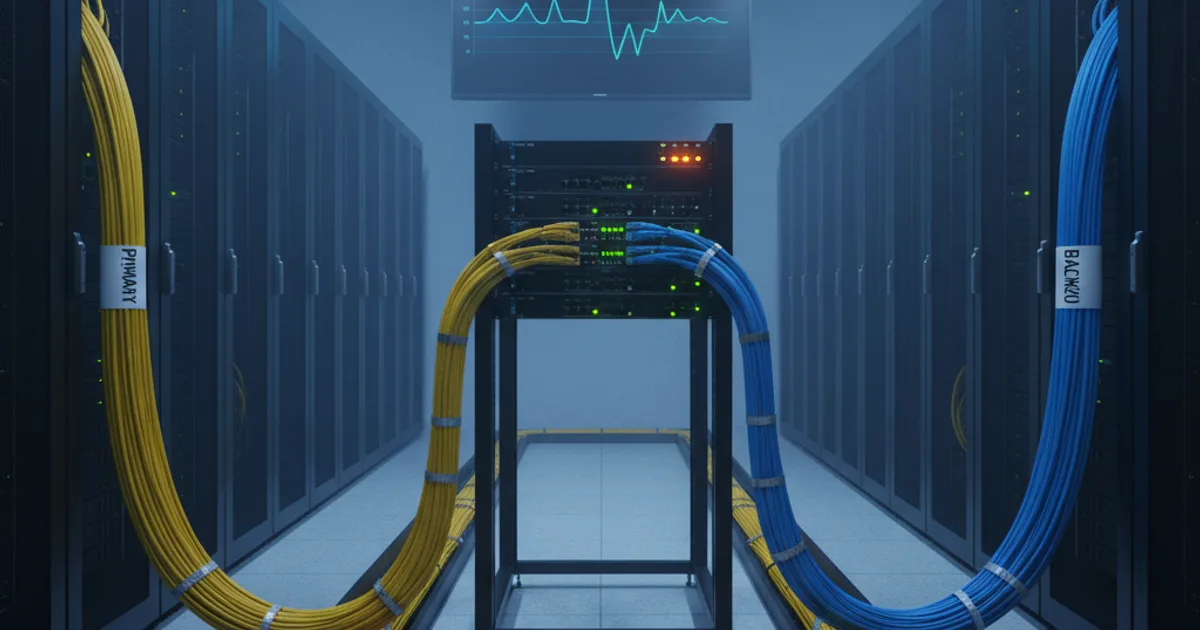
Multi-carrier SIP failover requires provisioning trunks across at least two independent carriers, configuring automatic rerouting rules on call failure, and layering network-level redundancy so that no single ISP or physical link grounds all voice traffic simultaneously.
The carrier layer is the first line of defense. Businesses prevent carrier-specific outages by provisioning SIP trunks across multiple independent carriers with automatic failover and pre-configured inbound routing, so a carrier DNS failure or maintenance window does not take down the phone channel. DIDlogic's SIP trunking failover guide recommends treating carrier diversity the same way IT treats cloud region diversity: redundancy must be tested under simulated failure conditions, not just designed on paper.
The network layer requires its own redundancy stack. Enterprises deploy primary leased lines alongside secondary connections from diverse ISPs and tertiary 4G or 5G routers as a last-resort path. Each layer must be capable of carrying the full call volume independently; partial-capacity backup links create a secondary degradation scenario rather than true failover.
The steps to build this architecture follow a clear sequence:
- Audit current carrier dependency and identify single points of failure in SIP trunk provisioning.
- Negotiate contracts with a second independent carrier and configure parallel inbound DID routing.
- Define failover trigger conditions in the SIP proxy or session border controller: typically call failure codes 503, 408, or 504.
- Configure network-level failover with diverse ISP connections and a cellular backup router on a separate physical path.
- Run scheduled failover drills quarterly, forcing traffic through each backup path to confirm capacity and routing integrity.
- Monitor carrier-level SLAs and latency from each path continuously, not only during incidents.
Agxntsix's AI Infrastructure practice treats this architecture as a prerequisite for any voice AI deployment, because an AI agent that handles inbound calls at scale needs the same uptime SLA as the business's most critical customer-facing system.
How does modern voice AI latency compare to traditional VoIP benchmarks?
Voice AI platforms add 400 to 620 milliseconds of end-to-end processing latency on top of network latency, which means the total perceived delay for an AI-handled call is 2 to 4 times the threshold that degrades a human-to-human VoIP call. Minimizing network latency is therefore more consequential for AI deployments than for standard VoIP.
Retell AI's 2026 benchmark review of voice AI providers reports that platforms such as ElevenLabs average 400 to 600 milliseconds of latency, while Retell AI itself averages 580 to 620 milliseconds. These figures represent the AI inference cycle: speech-to-text, language model processing, and text-to-speech synthesis. That cycle happens on every conversational turn, and it is additive to network round-trip time.
Traditional VoIP between two human agents tolerates up to 150 milliseconds one-way before quality degrades, according to bland.ai's acceptable latency reference. An AI deployment with 500 milliseconds of inference latency and 80 milliseconds of network latency delivers roughly 580 milliseconds total per turn, well above the human-VoIP comfort zone. Callers notice this as a slight but consistent pause before the AI responds.
The operational implication is that voice AI infrastructure must prioritize co-locating AI inference endpoints and telephony gateways as closely as possible. ElevenLabs' latency optimization guide specifically recommends selecting AI platform regions that match the geographic location of the SIP provider's interconnect points. AWS's network latency best practices framework echoes this: physical proximity between compute and network ingress is the single highest-leverage latency reduction available. For operations teams evaluating voice AI platforms for enterprise deployment, this co-location criterion should appear on the vendor scorecard alongside published latency averages.
What bandwidth and channel requirements are needed to support concurrent enterprise calls?
VoIP networks require 100 kbps per concurrent call for both upload and download streams, meaning an enterprise running 20 simultaneous AI calls needs at least 10 Mbps of dedicated upload bandwidth. Channel capacity planning follows a ratio of approximately one SIP channel per three to four employees.
The 100 kbps-per-call figure applies to standard G.711 codec traffic. G.729 compresses this to roughly 32 kbps, but G.711 remains preferred for AI deployments because compression artifacts interact poorly with speech recognition models. The 10 Mbps upload requirement for 20 concurrent calls, cited in Cebod Telecom's VoIP network testing guide, is a minimum floor, not a design target. Shared business internet connections with variable upload capacity will breach this floor during peak usage.
On the cost side, current enterprise SIP routing runs 10 to 25 dollars per channel monthly, with high-volume configurations dropping below 10 dollars per channel according to PBX.im's 2026 SIP trunk pricing analysis. Transitioning from legacy PRI lines to SIP trunking reduces monthly telecom bills by 25 to 65 percent. Per-channel costs have dropped more than 30 percent since 2020 due to bandwidth routing efficiencies, making the infrastructure economics of voice AI substantially more favorable than they were even three years ago.
For teams sizing infrastructure for AI-handled inbound volume, the practical sequence is: calculate peak concurrent call volume from historical CDR data, multiply by 100 kbps, add a 20 percent overhead buffer, and confirm dedicated (not shared) upload bandwidth at that capacity. AI infrastructure planning for voice channels should also account for SIP channel burst headroom during marketing-driven call spikes.
What monitoring metrics determine whether a live deployment is performing within spec?
Four metrics define whether a live voice AI deployment is operating within acceptable bounds: one-way latency below 100 milliseconds, jitter below 30 milliseconds, packet loss below 1 percent, and MOS at or above 4.0. Any single metric outside its threshold warrants immediate investigation before the issue surfaces as caller complaints.
Real-time monitoring requires instrumentation at the network edge, not only at the application layer. SIP session border controllers (SBCs) log per-call MOS scores and can alert operations teams when average MOS drops below 4.0 across a trunk group. Packet loss and jitter are best measured with continuous synthetic test calls on a separate monitoring path rather than inferred from production call quality reports, which lag real conditions by hours.
Failover and routing health need their own monitoring lane. Carrier response codes, registration refresh success rates, and SIP OPTIONS ping latency to each carrier should feed a single operations dashboard. A carrier that starts returning 503 responses at 2 percent of attempts is about to cause a partial outage; catching that trend before it reaches 10 percent is the difference between a managed failover and an emergency escalation.
Agxntsix embeds this monitoring layer into every voice AI deployment it operates, treating telephony health as a first-class operational metric alongside AI conversation quality scores. Operators who want to understand how to audit an existing voice AI deployment will find that most latency and routing failures have visible leading indicators that go unmonitored until a call crisis forces attention.
Sources
- What is Acceptable Latency for VoIP? Plus How to Stay Below It
- SIP Settings Mistakes Causing Call Drops
- VoIP Latency: Complete Guide to Understanding and Fixing Call Delays
- SIP Trunking Failover: Ensure Seamless Communication
- Latency in Business VoIP - Why It is So Important
- Common SIP Trunk Troubleshooting Tips and Fixes
- How to Reduce VoIP Latency: A Technical Guide to Testing Your Network
- What Is SIP Trunking: Unlock Seamless Telephony