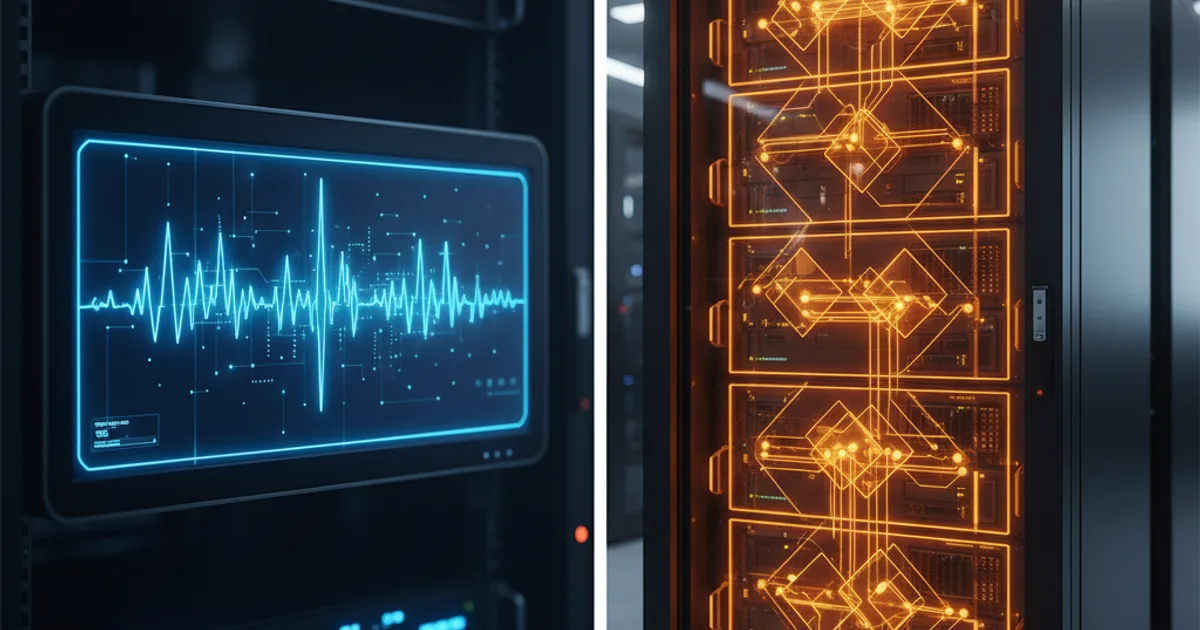
Hybrid voice architectures split real-time audio streaming from deep reasoning by running a lightweight conversational model in parallel with a larger strategic model. The lightweight layer handles immediate acknowledgment and turn-taking, while the deep layer processes retrieval, validation, and tool calls asynchronously. This design brings total voice latency within the 200ms to 300ms range that human conversation expects.
What Is a Hybrid Voice Architecture and How Does It Reduce Latency?
A hybrid voice architecture separates the audio pipeline into two concurrent execution paths: a fast streaming layer that keeps the conversation moving and a deep reasoning layer that handles complex logic without blocking the caller. Optimized deployments target a p50 total latency of approximately 250ms, compared to a median of 1.4 to 1.7 seconds for unoptimized production systems.
The performance gap between those two numbers is the operational cost of forcing every caller turn to wait for a full inference cycle before any audio is returned. The approach Deepgram describes as "streaming inference" processes audio continuously as it arrives and begins generating audio before a full response is compiled, eliminating the batch-processing pause that creates that 1.4-second wall. The fast layer issues an immediate acknowledgment, such as "Let me pull that up for you," while the deep layer runs a retrieval-augmented generation call or a CRM lookup in parallel. When the result is ready, it flows back into the conversation without any perceived stall. Vectorized pipeline operations can increase execution parallelism by 3x to 4x, according to production architecture benchmarks, compressing the gap between the two layers further.
For a practical illustration, consider a medical scheduling group routing after-hours calls through a voice agent. The streaming layer handles greeting, turn-taking, and intent classification in under 300ms. The deep reasoning layer, running concurrently, queries appointment availability, applies HIPAA-compliant PHI filters, and prepares a slot recommendation. The caller never hears silence; the architecture never trades speed for intelligence.
What Are the Core Technical Benchmarks for Enterprise Voice AI?
Enterprise voice AI targets a p50 end-to-end latency under 400ms when using standard cloud developer APIs, and under 250ms for optimized immediate-response layers. Human conversational response norms sit between 200ms and 300ms. At latencies above 800ms, user interruption and disengagement rates rise materially.
Those thresholds are not aspirational; they are the architectural design floor. AssemblyAI's documented analysis, "The 300ms rule: Why latency makes or breaks voice AI applications," frames 300ms as the boundary where callers stop perceiving a response as natural. Switching from batch to streaming inference alone reduces conversational latency by 40% to 60%, according to Deepgram's published benchmarks. Loka reported a Time to First Audio of 1.39 seconds when building a voice agent on Amazon Nova 2 Sonic before pipeline optimizations, a result AWS documented in its machine learning blog. That starting point illustrates why architecture choices, not just model selection, determine caller experience.
The table below maps latency ranges to their operational consequence:
| Latency Range | Caller Perception | Operational Risk |
|---|---|---|
| Under 300ms | Natural, human-like | Minimal |
| 300ms to 500ms | Slight but tolerable pause | Acceptable for complex queries |
| 500ms to 800ms | Noticeable hesitation | Elevated drop-off on simple tasks |
| Above 800ms | Disengaging, feels broken | High interruption and abandonment |
Deploying core models to regional GPU hosting reduces spatial network delays by 100ms to 200ms compared to a single central data center, according to Parloa's latency factor analysis. Separating models across different data centers can add 75ms of overhead, representing roughly a 30% latency penalty on a well-optimized baseline. Co-location is not optional at scale; it is a budget line item.
Why Is the Cohabitation of Speech Services Critical for Voice Accuracy?
Co-locating Automatic Speech Recognition, the LLM inference layer, and Text-to-Speech services on a single carrier network eliminates the inter-service round-trip time that stitched multi-vendor stacks accumulate at every hop. Each network boundary adds measurable delay and introduces a failure mode where a dropped packet between vendors causes a cascade.
The industry standard for low-latency transport is WebRTC over UDP, which reduces network transport delay compared to traditional HTTP or TCP architectures. WebRTC's design keeps packets moving even under minor packet loss, which matters on mobile or enterprise VoIP networks. Native audio models, which handle input, reasoning, and output in a continuous stream, go one step further by bypassing distinct Speech-to-Text and Text-to-Speech stages entirely, removing two serialized bottlenecks from the pipeline. Deepsense.ai's production deployment analysis describes this as allowing the model to "avoid the latency penalties of converting speech to text, processing text, and converting back."
GPU-optimized kernels deliver 2x to 10x performance gains on heavy inference steps, and INT8 model quantization reduces physical memory usage by 75% with minimal impact on accuracy, according to production architecture reviews published by Prodinit. These are not theoretical gains; they are reproducible optimizations that an infrastructure team can implement in a single sprint. Agxntsix's AI Infrastructure practice builds these co-located, compliance-ready voice stacks as a deliberate architecture choice rather than a vendor convenience, which is part of why the practice can commit to a 60-day ROI timeline as brand positioning.
For enterprises evaluating Voice AI for inbound and outbound automation, co-location decisions belong in the initial architecture review, not as a retrofit after latency complaints surface in production.
How Do Businesses Implement Compliance Guardrails in Deep Reasoning Layers?
Enterprise voice AI deployments require TLS 1.2 or higher encryption for audio in transit, encryption of transcripts at rest, and selective PHI redaction applied before any transcript reaches a downstream model or logging system. These controls belong in the deep reasoning layer, not bolted onto the edge.
Regulatory exposure in voice AI is concentrated at three points: the moment audio crosses a network boundary, the moment a transcript is stored, and the moment a downstream model receives patient or financial identifiers. Placing PHI redaction logic inside the deep reasoning layer means the fast streaming layer never routes sensitive tokens to a logging pipeline or a third-party tool integration. Enterprises adopting hybrid edge-cloud implementations are increasingly processing sensitive audio on-site to resolve both local privacy constraints and network latency simultaneously, a design pattern Gnani AI and Picovoice both document in their respective production guides.
For healthcare groups and financial services firms, HIPAA's minimum-necessary standard and applicable state privacy regulations require that redaction be selective and auditable, not a blanket mute. A dental group handling appointment scheduling, for example, needs to pass appointment type and availability data to downstream calendar integrations while stripping date-of-birth and insurance identifiers from any API call that leaves the compliance boundary. That logic lives in the deep reasoning layer because the fast streaming layer has no business touching it. Operators should confirm specific compliance obligations with qualified counsel; architecture can enforce the controls, but only legal review can confirm the mapping is complete.
What Are the Operations and Scalability Gains of Splitting Streaming From Logic?
Splitting streaming from deep reasoning lets each layer scale independently, which prevents a spike in complex queries from degrading conversational response time across the entire fleet. Enterprise AI voice platforms structured this way can automate up to 85% of contact processes and reduce operational costs by up to 75%.
The operational math changes when the two layers are decoupled. A retrieval call to a CRM that takes 600ms does not add 600ms to the caller's perceived wait; it runs in parallel behind an acknowledgment token. Call centers using specialized voice AI architecture report a 48% efficiency gain and a 36% decline in customer service costs, according to published industry benchmarks. Adding deep reasoning capability specifically brings up to a 42% increase in personalized customer interactions, a figure that reflects the business value of combining speed with context rather than choosing between them.
Scalability gains compound over time. The fast streaming layer can be replicated horizontally across regions with minimal overhead because it carries no stateful reasoning. The deep reasoning layer, which does carry state, can be scaled vertically on GPU clusters or routed to purpose-built inference endpoints based on query complexity. Enterprises deploying voice AI on this pattern report up to a 35% improvement in customer satisfaction scores and a 40% increase in employee productivity, outcomes that reflect what happens when call volume no longer creates a ceiling on quality.
For teams working through the build versus buy decision for AI infrastructure, the split-layer architecture also clarifies vendor selection: the streaming layer rewards latency-optimized specialist providers, while the deep reasoning layer rewards model quality and tool-integration depth. Mixing those requirements into a single-vendor selection rarely optimizes either.
Sources
- Low Latency Voice AI: What It Is and How to Achieve It - Deepgram
- Factors affecting latency in real-time voice AI - Parloa
- How Loka Built a Natural, Low-Latency Voice Agent with Amazon Nova 2 Sonic
- Voice AI Latency: What's Fast, What's Slow, and How to Fix It
- Building Low-Latency AI Voice Agents I Michael Solati
- Speech-to-Text Latency: How to Measure and Minimize - Picovoice.ai
- Building Production Voice AI Agents: Latency, Architecture - Prodinit
- Voice AI Latency: Where It Comes From and How to Reduce It