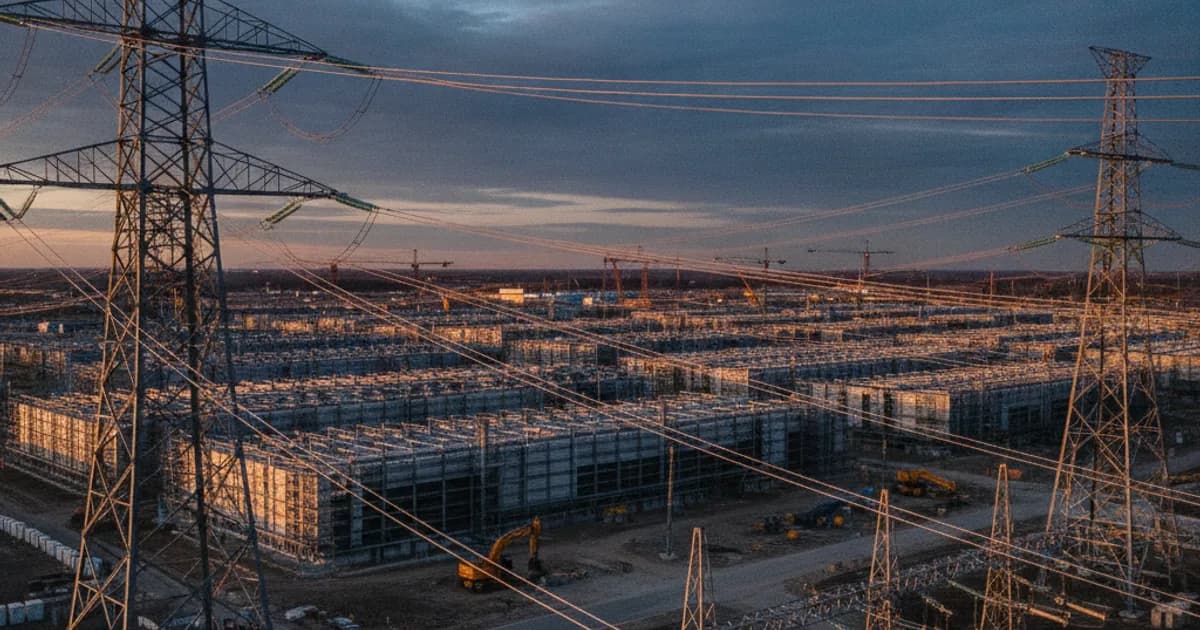
Federal energy initiatives are reshaping long-term private cloud capacity by redirecting AI data center construction toward federally controlled land with pre-permitted power infrastructure, bypassing years of local grid and zoning delays. The DOE has identified 16 specific sites, targets construction start by late 2025, and requires projects to cross a 100 MW and $500M capital threshold to access fast-track permitting.
How will projected AI energy demand growth impact private cloud hosting capacity through 2030?
U.S. data center electricity demand is projected to reach 426 TWh by 2030, a 133% increase from the 183 TWh consumed in 2024, according to DOE research published via the Belfer Center at Harvard. Data centers are expected to account for 25% of all new U.S. electricity demand by 2030, which means that private cloud operators who have not locked in power capacity now face a structurally tighter market in three to five years.
The Pew Research Center reported in October 2025 that data centers already represented 4% of total U.S. electricity use in 2024, with that share projected to climb to between 6.7% and 12% by 2028. That range reflects genuine uncertainty about how fast AI workloads scale, not a comfortable spread to plan around. For enterprise operators running private cloud infrastructure or evaluating hybrid architectures, the practical implication is straightforward: energy scarcity will constrain capacity additions as surely as capital or hardware supply chains. Hyperscalers are projected to spend $364 billion on data center construction in 2025 alone, per Deloitte's analysis of U.S. infrastructure trends, crowding out mid-market buyers in both the power and real estate markets.
Global demand adds further pressure. The Brookings Institution projects global data center electricity usage will reach 945 TWh by 2030 and 1,200 TWh by 2035, meaning domestic capacity decisions are being made inside a worldwide competition for the same equipment, land, and grid interconnection queues.
How does co-location on federal lands resolve local utility grid bottlenecks?
The DOE federal land co-location program resolves grid bottlenecks by offering sites with existing, in-place energy infrastructure, including nuclear power options, on land that bypasses local zoning and permitting hurdles that have stalled commercial data center projects for years. The DOE has identified 16 federal sites specifically chosen for their existing energy adjacency.
Local interconnection queues are one of the most concrete barriers to new data center construction in the commercial market. A site that clears environmental review, secures zoning, and still waits three to five years for a utility interconnection agreement is a site that delivers no capacity when the business needs it. As Landgate's analysis of the DOE initiative notes, the program explicitly targets this bottleneck by co-locating facilities with "existing, in-place energy infrastructure" on federal land where the DOE controls permitting pathways. The DOE's own request for information, published in the Federal Register in April 2025, describes the goal as accelerating deployment by integrating clean energy sources directly at the site rather than routing load through constrained transmission corridors.
For private cloud operators, particularly those in regulated industries like financial services, healthcare, or government contracting, a federally sited facility also simplifies the compliance conversation around data residency and physical security audits. The DOE's AI Infrastructure on DOE Lands Request for Information is the formal entry point; businesses seeking more detail can contact businesshub@hq.doe.gov with the subject line "Load Growth."
What are the minimum capital and power requirements to qualify for fast-track federal permits?
To access FAST-41 federal permitting and Commerce Department financing, a data center project must commit to at least $500 million in capital investment and require at least 100 MW of incremental electrical load. Both thresholds must be met together; meeting only one does not qualify a project.
FAST-41, established under the Fixing America's Surface Transportation Act, is the federal permitting coordination process managed by the Federal Permitting Improvement Steering Council. For data center developers, hitting the $500M and 100 MW floor compresses a permitting timeline that otherwise runs two to four years into a structured, time-bound review. The White House's July 2025 executive action on accelerating federal permitting of data center infrastructure reinforced FAST-41 as the primary vehicle for qualifying projects.
The 100 MW threshold deserves operational context. Consumer Reports and DOE research both note that AI data centers are transitioning density requirements from roughly 5 MW to 50 MW for a five-acre site, a tenfold increase. A single hyperscale facility requires a minimum of 100 MW and the largest can require 5 GW or more. This means the FAST-41 floor is calibrated for hyperscale and large enterprise deployments, not for mid-market operators building 10 to 20 MW facilities. Mid-market operators must either aggregate demand through colocation agreements or operate under standard permitting timelines.
| Threshold | Requirement | Program Access |
|---|---|---|
| Minimum capital commitment | $500 million | FAST-41 permitting + Commerce Dept. loans/grants |
| Minimum incremental load | 100 MW | FAST-41 permitting + Commerce Dept. loans/grants |
| Typical AI data center density (new builds) | 50 MW per 5-acre site | Baseline planning figure |
| Traditional data center density | 5 MW per 5-acre site | Legacy benchmark |
| DOE national lab exascale PUE | 1.03 | Efficiency reference standard |
| DOE program construction target | Late 2025 start, 2027 operational | Federal site timeline |
What environmental and compliance standards must businesses navigate when using federal sites?
Federal land data center awardees bear full construction costs and must satisfy federal environmental review under NEPA, water use disclosure requirements, and any applicable clean energy co-location terms set by the DOE lease or easement. Under the federal land lease structure, the DOE provides the ground lease; the developer owns every compliance obligation on top of it.
Water use is emerging as an equal constraint alongside power. The Lincoln Institute of Land Policy's report "Data Drain: The Land and Water Impacts of the AI Boom" notes that AI data centers in the U.S. are projected to require 32 billion gallons of water annually by 2028, with individual large facilities consuming up to 5 million gallons daily. Federal sites near arid DOE properties, including several of the 16 identified locations adjacent to nuclear and energy research facilities, will face water rights negotiations as a core permitting issue, not a secondary one.
From a compliance standpoint, enterprises in healthcare, financial services, or government contracting must layer their sector-specific obligations, HIPAA for health data, FedRAMP for cloud services sold to federal agencies, and applicable state data center regulations, onto the federal land lease terms. The law firm K&L Gates published a Q&A specifically addressing what "data centers and energy-intensive infrastructure developers and operators need to know" about this compliance stack, noting that the interaction between federal leases and state environmental permitting is not fully resolved in current guidance. Businesses should confirm their specific compliance posture with counsel before committing capital.
How does the AI energy surge affect Power Purchase Agreement pricing for enterprise operators?
Power Purchase Agreement prices rose 35% in 2024 due to AI-driven energy procurement competition, according to DOE and industry data cited in Brookings Institution analysis. That single-year increase eliminates a significant share of the cost advantage that private cloud operators historically held over public cloud alternatives.
PPAs are the primary mechanism through which large data center operators lock in long-term power prices. A 35% annual increase compresses margin on any infrastructure investment that was underwritten at pre-2023 energy cost assumptions. For enterprise operators who made five to seven year capacity decisions before 2022, that repricing is a real exposure. The DOE's federal land program partially addresses this by co-locating facilities with clean energy sources, which can qualify for federal tax credits and provide more stable long-run power economics than open-market PPA procurement.
A 10% increase in cloud adoption raises enterprise energy productivity by 0.55%, equivalent to $46.70 per MWh in gross value added, according to research cited by Raul Katz on LinkedIn referencing a comparative assessment of energy productivity in U.S. cloud infrastructure. That figure suggests cloud consolidation has a genuine energy efficiency dividend, but the dividend is only realizable if underlying power costs remain predictable. When PPA pricing moves 35% in a year, that productivity gain is partially offset at the infrastructure level.
AI Data Center Energy and Demand: Key Figures
| Metric | Value | Source |
|---|---|---|
| U.S. data center electricity use, 2024 | 183 TWh (4% of total U.S. electricity) | Pew Research Center, October 2025 |
| U.S. data center electricity use, 2028 projection | 6.7%, 12% of total U.S. electricity | DOE / Belfer Center |
| U.S. data center demand, 2030 projection | 426 TWh (+133% from 2024) | DOE research |
| Share of new U.S. electricity demand, 2030 | 25% | DOE / Belfer Center |
| Global data center demand, 2030 projection | 945 TWh | Brookings Institution |
| Global data center demand, 2035 projection | 1,200 TWh | Brookings Institution |
| PPA price increase, 2024 | +35% year-over-year | Brookings Institution |
| Hyperscaler data center construction spend, 2025 | $364 billion | Deloitte |
| Projected U.S. AI data center water use, 2028 | 32 billion gallons/year | Lincoln Institute |
What should enterprise operators do now to protect long-term private cloud capacity?
Enterprise operators should audit their current power contracts, model 2027 to 2030 capacity scenarios against the DOE's published demand projections, and determine whether their colocation or owned-infrastructure footprint can scale without relying on open-market PPA availability at 2022 prices. The window to act before grid constraints tighten is measured in months, not years.
The DOE's initiative is primarily calibrated for hyperscale deployments above $500M and 100 MW. Most enterprise operators sit below that threshold and must take a different path. Practically, that means evaluating colocation agreements with providers who have already locked in federal site access or long-term clean energy contracts, treating power availability as a first-order factor in vendor selection alongside latency and security, and building energy cost volatility explicitly into total cost of ownership models for any AI workload.
For enterprises running AI workloads on private or hybrid cloud, the energy constraint connects directly to AI infrastructure design. An AI stack that runs efficiently, with well-scoped agents, optimized inference calls, and a clean unified data layer rather than redundant retrieval loops, consumes materially less compute and power than a poorly architected one. Agxntsix's AI Infrastructure practice addresses exactly this layer: building the data and automation architecture that lets enterprise AI workloads run on the minimum necessary compute rather than brute-forcing every query against an oversized stack. That design discipline becomes a cost and capacity advantage as power prices rise.
Businesses with genuine interest in federal site eligibility or DOE clean energy resources can contact businesshub@hq.doe.gov with the subject line "Load Growth" as the DOE's published guidance directs.
Sources
- AI Data Centers: Big Tech's Impact on Electric Bills, Water, and More
- DOE's Initiative to Build AI Infrastructure on Federal Lands - Landgate
- Data Drain: The Land and Water Impacts of the AI Boom
- DOE Seeks Information on AI Infrastructure, Including Data Centers
- AI, Data Centers, and the U.S. Electric Grid: A Watershed Moment
- AI Infrastructure on DOE Lands Request for Information
- US data centers' energy use amid the artificial intelligence boom
- DOE Identifies 16 Federal Sites Across the Country for Data Center ...