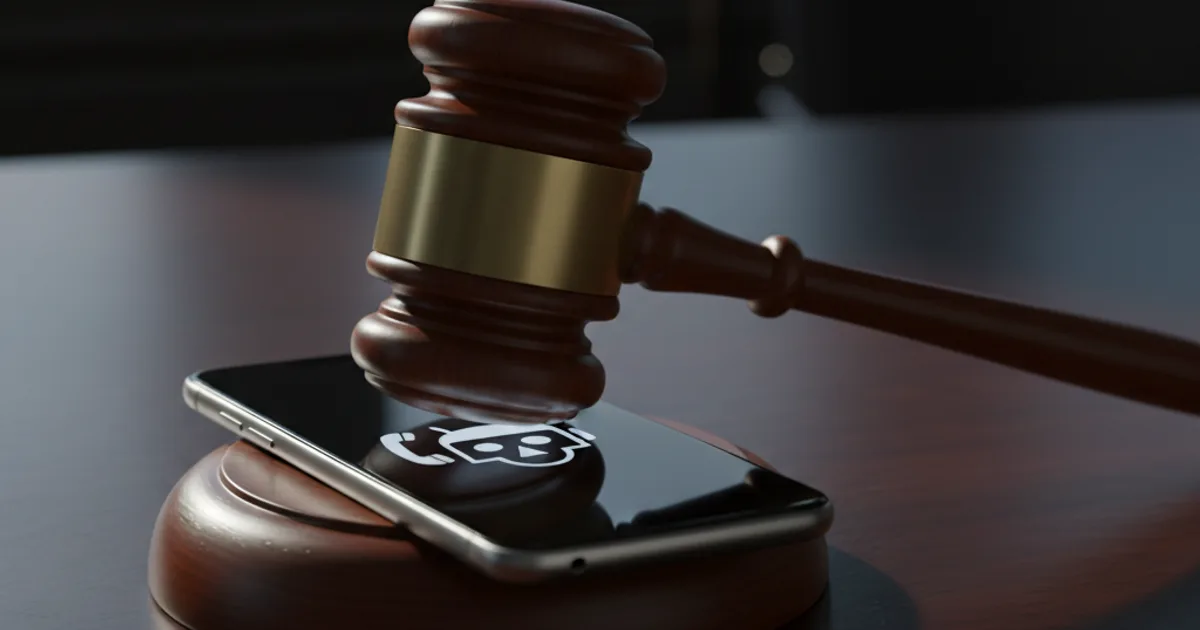
AI voice calling is no longer a regulatory grey area. The FCC resolved that question in February 2024, and the compliance obligations that followed are now the operating baseline for any enterprise running outbound AI campaigns.
Are AI-generated voice calls subject to TCPA regulations?
AI-generated voice calls are fully subject to TCPA restrictions as artificial or prerecorded voice calls. The FCC's February 8, 2024 Declaratory Ruling confirmed this classification explicitly, closing any loophole argument that a "human-like" AI voice operated outside the statute. Every outbound AI voice call to a U.S. number must meet the same consent, identification, and opt-out requirements as a traditional robocall.
The practical implication is that businesses cannot treat AI calling as a separate category with lighter rules. The TCPA does not distinguish between a synthesized voice and a recorded human voice; it looks at whether the call was placed without a live agent dialing. The FCC ruling, detailed in analysis published by Mayer Brown and Wiley Law at the time, makes clear that the agency asserted authority and intent to regulate AI-generated voices under the existing statute rather than wait for new legislation. If your call infrastructure generates a human-like voice programmatically, you are operating inside TCPA territory.
How did the FCC's February 2024 declaratory ruling classify AI voices?
The FCC's February 8, 2024 ruling classified calls made with AI-generated voices as falling within the TCPA's "artificial or prerecorded voice" category, which triggers the full set of consent and identification obligations under the Act. The ruling did not create a new AI-specific rule; it confirmed that existing restrictions already cover this technology.
This distinction matters operationally. Businesses that had been running AI outbound programs under the assumption that the rules were unsettled now have no ambiguity to rely on. The FCC, as reported by Mayer Brown's analysis of the ruling, declared both authority and intent to regulate. That means enforcement posture has shifted, not just the text of the rule. Any voice AI stack deployed for outbound calls needs to be designed from the start around documented consent, DNC suppression, and call-window controls, not retrofitted after a warning letter arrives.
What are the consent requirements for marketing versus non-marketing AI calls?
Outbound marketing calls using an AI-generated voice require prior express written consent for each number dialed. Non-marketing informational calls require at least prior express consent, though narrow statutory exemptions exist for certain emergency or healthcare contexts. The written consent standard for marketing is the stricter of the two and demands a clear, affirmative opt-in, not inferred permission from a prior business relationship.
The operational gap most businesses miss is the difference between having a consent record and having a defensible consent record. Prior express written consent must document what the consumer agreed to, the specific calling purpose, the date and source of consent, and the number consented. A checkbox buried in a privacy policy does not meet the standard. Consent capture needs to be purpose-specific, timestamped, and stored in a format that survives a discovery request. Understanding how AI infrastructure supports compliant data capture is relevant here: consent records stored in disconnected CRM fields or flat spreadsheets are difficult to produce under litigation timelines.
What is the financial risk of non-compliant AI calling campaigns?
Statutory TCPA damages run $500 to $1,500 per call or violation, with the higher figure applying when a violation is found to be willful or knowing. A non-compliant 10,000-call campaign creates a theoretical statutory exposure of $5 million to $15 million. A 50,000-call campaign under stress-test modeling carries $25 million to $75 million in exposure, before attorneys' fees or class certification.
These numbers are not hypothetical worst cases; they are the math the statute produces when applied at call volume. DNC registry breaches carry a separate enforcement vector: fines of up to $43,792 per violation as a Federal Trade Commission penalty, independent of per-call TCPA damages. The combination of class action exposure and regulatory fines means a single non-compliant campaign can produce liability that exceeds the annual revenue of the business running it. This is why compliance infrastructure is not a legal budget line item; it is an operational risk control that belongs in the same category as insurance and fraud prevention.
How can businesses build compliant consent and opt-out workflows for AI calling?
A compliant AI calling workflow requires four interconnected controls: purpose-specific consent capture at the point of lead acquisition, real-time DNC suppression against both the National Do Not Call registry and the company's internal suppression list, automated opt-out processing with a target response time under 2 seconds, and immutable audit logs retained for at least 5 years. Each control must be verifiable, not just documented in policy.
The National DNC database requires scrubbing on a 31-day cycle as a standard operational practice, per compliance guidance from sources including RetellAI's 2026 playbook and Kixie's compliance documentation. Internal DNC lists must be maintained separately and honored independently of the national registry. Opt-out requests received during an AI call need to trigger immediate suppression across all future campaigns tied to that number; the 2-second response-time target referenced in automated opt-out platforms reflects the operational expectation for real-time suppression.
Audit logs need to capture the consent text, the source and channel where consent was collected, the timestamp of consent, any revocation events, and the number-level suppression status at the time each call was placed. Industry compliance guidance consistently recommends a minimum 5-year retention window. Agxntsix's AI Infrastructure practice builds these consent and suppression layers into the calling stack from initial deployment, so the audit record is a byproduct of normal operations rather than a reconstruction effort after the fact.
Are there calling-window and identification requirements for AI voice calls?
AI voice calls must be placed between 8:00 AM and 9:00 PM in the called party's local time, the same window the TCPA applies to traditional telemarketing. Businesses must also clearly identify themselves at the start of every call, and compliance guidance now broadly recommends explicit disclosure that the caller is an AI, not a live agent.
The identification requirement has both a compliance and an operational dimension. On the compliance side, failure to identify the calling party at call initiation is an independent violation basis. On the operational side, explicit AI disclosure reduces abandonment friction and positions the business against future state-level AI transparency requirements, several of which are already moving through legislatures. States including California have enacted laws touching AI interaction disclosure, and the federal regulatory direction from the FCC's 2024 ruling suggests disclosure will only become more formal over time. Building disclosure into the call script now is cheaper than retrofitting it under a consent order. For businesses running outbound voice AI programs, the call-open script is a first-line compliance control, not just a UX decision.
What records must a business maintain to defend a TCPA claim?
To defend against a TCPA claim, a business must produce consent documentation showing the specific number, the consent language presented, the source and channel, the timestamp, and any subsequent revocation or suppression events. Consent and call logs should be retained for at least 5 years, per industry compliance guidance from sources including RetellAI and VoiceAIWrapper. Immutable records that cannot be altered after the fact carry significantly more evidentiary weight than database entries that could be modified.
The practical failure mode in most operations is not that consent was never collected; it is that consent was collected in one system, call records exist in another, and suppression events live in a third. When those three systems cannot be joined on a number-level key, producing a clean consent-to-call chain for a single disputed number under a discovery deadline becomes expensive and unreliable. An integrated data layer that ties lead source, consent record, call log, and suppression status to the same number identifier is not a compliance luxury; it is the minimum architecture needed to defend at scale.
Sources
- TCPA and AI Calling in 2026 for Sales Teams - Kixie
- TCPA Compliance | Voice AI Telemarketing - VoiceAIWrapper
- The 2026 TCPA Compliance Playbook for Voice AI Outbound
- TCPA Compliance for AI-Powered Outbound Calls
- AI Voice Agent Compliance: TCPA Rules, FCC Requirements ...
- The 2025 TCPA & FCC Compliance Checklist for AI Voice Calls in ...
- FCC Declares Authority and Intent to Regulate AI-Generated Calls ...
- TCPA Compliance for AI Calls: Practical Guide