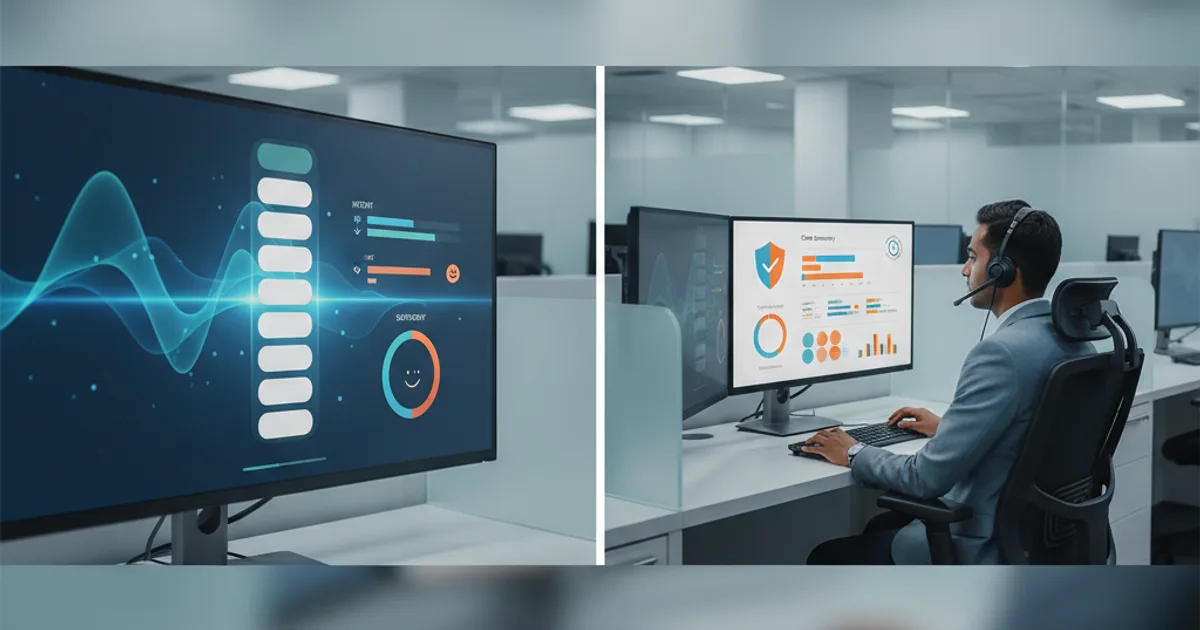
Enterprise voice AI resolves 60% to 80% of routine calls without human involvement, according to data cited by Kore.ai. The 20% to 40% that escalate are where revenue, compliance, and customer trust are actually won or lost. Getting the handoff architecture right is not optional.
How does a warm handoff protocol protect customer experience during voice AI transfers?
A warm handoff protocol delivers a structured summary to the human agent before the call connects, including the caller's intent, extracted entities, sentiment score, and stated goal. This eliminates the restart problem: the caller does not repeat themselves, and the agent arrives with context. According to Cresta, hybrid escalation flows shrink the CSAT gap between AI and human agents to just 0.05 points.
Without a warm handoff, agents open cold. The caller repeats account details, explains the problem again, and frustration compounds. Dialzara reports that 63% of customers leave a business after a single bad bot experience, and a cold transfer is one of the most common triggers. The evidence pack the AI passes must include data lineage and permissions chains, not just a transcript snippet, so the agent can act immediately rather than verify from scratch.
In practice, this means your voice AI platform must structure its handoff payload as a machine-readable object, not a freeform text summary. Fields should map directly to your CRM record: caller ID, account tier, intent classification, conversation stage, and a confidence score on the AI's last action. Agxntsix builds this data bridge as part of its AI Infrastructure layer, connecting the voice agent's session state to CRM and ticketing systems so the receiving agent sees a pre-populated case, not a blank screen.
What are the best practices for setting up telephony escalation rules in voice AI systems?
Escalation rules should trigger on three signal types: intent signals the AI cannot resolve, sentiment crossing a defined negative threshold, and explicit caller requests for a human. The average escalation rate across contact centers runs 15% to 20% of total calls, so rules that are too loose inflate cost while rules that are too tight damage experience.
Start by mapping agent skills to intent categories before writing a single routing rule. A billing dispute requires different skills than a clinical intake question. Route by intent first, then by agent availability, then by queue depth. Voiso's escalation guidance recommends building a tiered routing model where each tier has a defined authority limit. For example, refund authority thresholds for lower-tier agents can be mapped to the 70th percentile of historical refunds, up to $100, with automatic escalation above that threshold.
Sentiment scoring adds a second routing dimension. If a caller's sentiment drops below a configured threshold mid-call, the system should escalate even if the intent is routine. Negative sentiment is a leading indicator of churn, and catching it before the call ends is cheaper than a recovery campaign afterward. Build sentiment thresholds as configurable parameters, not hardcoded values, so operations teams can adjust them without a developer.
For a practical architecture overview of how modern systems replace rigid IVR trees with dynamic routing, the LiveKit post on the handoff pattern for voice agents covers the structural mechanics in detail.
When should voice AI systems use a propose-commit architecture?
A propose-commit architecture is required any time the AI agent would execute an action that is high-risk, sensitive, or irreversible without human review. In regulated environments such as healthcare and financial services, the AI pauses mid-interaction, proposes the action with supporting evidence, and waits for human approval before proceeding. This is the correct model for prescription changes, large-value refunds, account closures, and loan modifications.
The propose-commit pattern is not a fallback for failure; it is an intentional design choice for actions where the cost of an error exceeds the cost of a brief delay. The AI continues the conversation, tells the caller a specialist is confirming the action, and holds state. If the human approves, execution completes without re-queuing. If the human rejects or modifies the proposal, the AI receives the updated instruction and proceeds accordingly.
This architecture also satisfies audit requirements. Every proposed action carries a structured evidence pack showing why the AI recommended it, which data it used, and which permissions were in scope. That record is the documentation a compliance team needs during a review, and it exists automatically rather than being reconstructed after the fact.
How do risk-based decision lanes satisfy compliance and auditing requirements?
Risk-based decision lanes assign each potential AI action to a risk tier, then apply time-boxed approval windows before execution. If an approval times out, the action fails to a safe-denied state rather than executing by default. This prevents automation bias, where a system acts because no one objected rather than because someone approved.
For compliance purposes, the lanes create an auditable decision trail. SOC 2 Type II, ISO 27001, HIPAA, and PCI-DSS all require demonstrable controls over who authorized what and when. A time-boxed approval with a logged outcome satisfies the authorization control requirement that auditors look for. The denied-by-default timeout behavior satisfies the fail-safe principle that security frameworks require.
Operationally, risk tiers typically map to three lanes: fully autonomous execution for low-risk actions (address updates, appointment confirmations), propose-commit for medium-risk actions (refunds within policy, schedule changes), and full human takeover for high-risk actions (account closures, clinical escalations). The thresholds between lanes are set by the operations team in consultation with compliance, not by the AI vendor alone.
For businesses operating in healthcare, the human-in-the-loop pattern guide from LiveKit provides a useful technical reference for structuring approval flows within a voice agent session.
What operational metrics quantify the financial impact of hybrid AI-human contact centers?
Hybrid AI-human handling drives a 71% reduction in cost-per-resolution compared to all-human baselines, according to Kore.ai. The cost differential between a human-escalated call ($12 to $25) and a first-call resolution ($5 to $8) means every percentage point of escalation rate has real dollar value at enterprise call volumes.
The metrics that matter most for an operations review are: first-contact resolution rate, escalation rate, average handle time, and cost-per-resolution. Agentic voice deployments produce 5 to 15 point improvements in first-contact resolution, and AI data pre-collection reduces average handle time by 20% to 50%, reaching 60% in high-volume environments. Those are not projections; they are operational outcomes cited in Kore.ai's 2026 enterprise voice trends analysis.
Track the CSAT delta between AI-resolved calls and escalated calls separately. If that delta is large, your escalation rules are either triggering too late (customers already frustrated before transfer) or your warm handoff payload is incomplete (agents restarting the conversation). Both are diagnosable and fixable with the right telemetry. Agxntsix surfaces these metrics through its unified data layer, connecting voice session data to CRM and workforce management dashboards so operators see the full picture in one place.
How does a shadow mode stage improve live voice AI performance before launch?
Shadow mode runs the voice AI in parallel with live call handling for two weeks before go-live, comparing the AI's routing decisions against actual agent decisions without taking any real actions. This calibrates intent classifiers, escalation thresholds, and sentiment triggers against real traffic before the system carries responsibility for outcomes.
Two weeks is the operational standard for a single use case. During that window, the operations team reviews divergence cases: calls where the AI would have routed differently than the human agent. Each divergence is a calibration signal. High-frequency divergences indicate a misconfigured intent model or a threshold set on synthetic data that does not match your actual caller population.
Shadow mode also surfaces compliance gaps before they become incidents. If the AI would have executed an action that requires a propose-commit gate and the gate is not yet configured, shadow mode catches it. After shadow mode, reliable implementations target a first-call resolution accuracy benchmark of 95% or greater before routing live traffic. Launching below that threshold means the error volume is high enough to damage CSAT at scale.
Agxntsix structures the shadow mode period as part of its standard deployment protocol, with calibration reviews at day 7 and day 14, so teams reach go-live with routing rules validated on their own call data, not on vendor benchmarks from a different industry.
How do you maintain agent readiness when voice AI handles most volume?
When voice AI handles 90% or more of incoming calls autonomously, human agents spend most of their time on exception cases rather than routine volume. That changes what agent readiness means. Skills atrophy on the routine tasks the AI has absorbed, while complex case handling demands sharpen.
Voice AI-assisted training tools lower new-hire ramp times by 50% to 85%, with an 85% reduction reported specifically in healthcare contact centers. That efficiency comes from AI simulating call scenarios during onboarding rather than waiting for live call volume to provide practice. The same simulation capability works for ongoing skills maintenance: agents can practice the exception cases the AI escalates without waiting for those calls to arrive organically.
Structure agent workflows so that every escalation includes a debrief tag: was the escalation correctly triggered, was the handoff payload complete, and was the resolution within the agent's authority tier. Those tags feed back into routing rule refinement and become the continuous improvement loop that keeps the system calibrated over time. A voice AI deployment that never improves its routing rules after go-live will drift, because caller behavior and product offerings change even when the AI model does not.
Sources
- Chat vs. Voice: AI-Human Handoff Strategies - Dialzara
- Enhance Customer Satisfaction with Expert Call Escalation - Voiso
- The Handoff Pattern for Voice Agents That Replaces IVR Menus
- How Voice AI Agents Improve Customer Interactions: 8 Ways - Balto
- Best Practices for AI to Human Agent Handoffs - Cresta
- Best AI Voice Platforms for Call Centers With Human Handoff - Fini AI
- Agentic voice for enterprise: What it is, ROI & 2026 trends - Kore.ai
- The Human-in-the-Loop (HITL) Pattern for Voice Agents | LiveKit