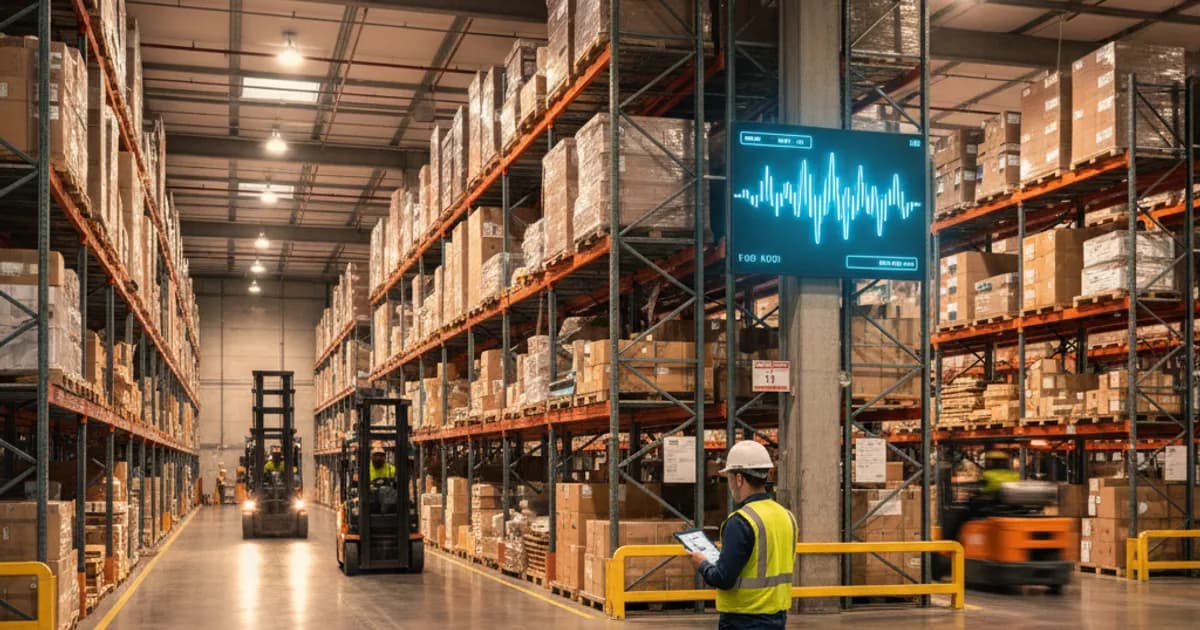
Dallas sits at the intersection of two converging forces: one of North America's most active freight corridors and a maturing AI ecosystem that Heartland Forward research credits with 22,000 AI-skilled jobs and 816 AI patents. For operators running distribution centers, 3PLs, or regional fleets in the Metroplex, that combination makes AI adoption a practical operational question, not a future one.
How does voice AI automate customer interactions and tracking for Dallas logistics firms?
Voice AI replaces legacy IVR trees with conversational agents that answer shipment-status calls, rebook deliveries, and escalate exceptions without a human dispatcher. Dallas implementations connect to TMS and WMS platforms via custom webhooks, giving the agent real-time data to quote. According to Global Trade Magazine, average customer response times drop from 18 minutes to 3 minutes once comprehensive automation is live.
The architecture is simpler than most operations leaders expect. Voice AI rides on top of existing telephony infrastructure through SIP trunking or call forwarding, so there is no rip-and-replace of phone systems. The agent reads from the same shipment data a dispatcher would pull, answers in English or Spanish to match the Texas workforce demographic, and logs every interaction back into Salesforce or HubSpot through real-time webhook sync. Calls that require judgment, a damaged freight claim, a redelivery exception with a shipper penalty clause, route to a live agent with a full transcript already attached.
For a regional distributor running a single contact-center team across three shifts, that routing model alone eliminates most of the overnight and weekend staffing gap without changing daytime operations at all.
What are the specific steps to implement voice AI within an existing supply chain architecture?
A Dallas logistics voice AI deployment follows five sequential phases: infrastructure audit, data-layer integration, bilingual model configuration, compliance validation, and phased call routing. The full sequence typically runs eight to twelve weeks. Skipping the data-layer step is the most common failure mode: an agent with no live TMS feed answers in generalities and destroys caller trust fast.
Here is the standard implementation sequence Agxntsix runs for distribution clients:
- Infrastructure audit. Map existing telephony (PBX, SIP, or hosted VoIP), CRM schema, and ERP/TMS/WMS API availability. Identify data latency bottlenecks: sub-second latency is the hard threshold for natural conversation flow.
- Data-layer integration. Build webhook connections to the TMS for shipment status, the WMS for inventory queries, and the CRM for account identification. AI operates as an orchestration layer over these systems, not a replacement for them.
- Bilingual model configuration. Configure English and Spanish speech models. Texas logistics operations handle significant Spanish-language call volume, and misrouted bilingual callers abandon calls at high rates.
- Compliance validation. Confirm SOC 2 Type II, PCI-DSS for payment interactions, and HIPAA if the distribution network touches pharmaceutical or medical-device freight. Role-based access controls and prompt-response audit logs are required before go-live.
- Phased call routing. Start with one call type (shipment status inquiry) before expanding to rescheduling, claims intake, and outbound delivery notifications. Pilot volume gives the team real data to tune before full rollout.
Dallas operators planning go-live windows should note that the regional logistics calendar compresses around the State Fair of Texas each fall, when inbound freight and carrier capacity spikes. Scheduling the cutover before or after that window reduces noise in early performance data.
What operational and financial metrics prove the ROI of voice AI in Texas distribution networks?
Dallas logistics deployments typically capture 70% to 85% of projected cost savings in the first six months, with a further 15% to 25% efficiency gain following post-launch optimization, according to data from Talos Automation. Automation of customer support alone generates up to a 75% reduction in total service costs. Those two numbers together define the financial case without requiring revenue-growth assumptions.
Beyond cost, the conversion math matters for any distributor with an inbound sales line. Texas businesses deploying AI automation report 3x to 5x faster customer response and 20% to 40% higher lead-conversion rates, per TxEDC research. Distributors specifically report up to 30% savings on inventory carrying costs, 20% on logistics operational costs, and 15% on procurement when AI integration runs across the full operation. Supply chain organizations running AI-mature operations are 23% more profitable than competitors, according to IBM Institute for Business Value research. None of these gains require a full digital transformation: they follow from connecting an AI orchestration layer to the data systems already running the operation.
For a practical benchmark: a Dallas enterprise deploying comprehensive automation reports average first-year productivity gains of 65%, revenue growth of 28%, and overall expense cuts of 72%, per HummingAgent location data. Agxntsix's practice targets 60-day ROI as a positioning standard, which aligns with the six-month cost-capture window the Dallas data shows.
What compliance and infrastructure standards must a Dallas logistics provider meet when deploying AI?
Dallas logistics AI deployments must clear SOC 2 Type II, PCI-DSS for any call handling payment data, and HIPAA for freight networks touching medical or pharmaceutical cargo. Infrastructure requirements include sub-second voice latency, role-based access controls, and auditable prompt-response logs for every AI decision touching financial or customer data.
Compliance is not optional overhead: it is the gate that determines whether enterprise shippers will accept you as a carrier or 3PL. More than 40% of shippers now verify a logistics partner's AI competencies when selecting providers, according to Open Sky Group supply chain statistics. That means your AI governance framework is part of your sales story to the Fortune 500 accounts in the Dallas freight corridor.
AI governance in enterprise logistics runs on three mechanisms: policy guardrails that define what the agent can and cannot commit to, role-based access that limits which data the agent surfaces to which caller type, and prompt-response audits that create a retrievable record for dispute resolution. On infrastructure, PCI-DSS compliance for voice channels requires that card data never touches the AI layer directly; payment capture routes to a compliant IVR vault with the AI agent stepping back during the transaction.
How does local voice AI transition a business's operating costs from fixed to variable?
Voice AI converts a fixed contact-center staffing line into a usage-based cost that scales with call volume rather than headcount. A Dallas distributor handling 2,000 inbound calls per month pays for AI capacity, not for eight agents on three shifts. Gartner's 2026 forecast projects a 70% reduction in human contact-center workload and a 24% improvement in customer satisfaction scores from voice AI deployment.
This shift changes the unit economics of growth. Adding a new distribution lane or onboarding a large retail account traditionally triggered a hiring cycle: more volume meant more dispatchers, more trainers, more supervisors. With an AI voice layer handling status calls, rescheduling, and first-line exception triage, incremental volume hits the AI queue first. Human staff handle the genuinely complex cases, which tend to be a small and relatively stable fraction of total call volume. The cost curve flattens even as throughput grows.
Texas small businesses show what this looks like at a smaller scale: AI automation drives a 60% to 80% reduction in administrative time and eliminates call and email backlogs without adding headcount, per TxEDC data. For a regional distributor, the same logic applies to the contact center as a whole. Understanding how voice AI infrastructure connects to broader AI readiness helps operators sequence the investment correctly before committing to a full rollout.
What benchmarks define AI adoption rates and market growth in the logistics industry?
Logistics leads all sectors in AI tool adoption: 72% of logistics employees used AI tools in 2024, the highest single-year adoption rate across any industry, according to supply chain AI statistics compiled by Open Sky Group. The supply chain AI market is valued at $9.94 billion in 2025 and is projected to reach $236 billion by 2035.
The gap between intent and execution is significant. Although 94% of supply chain businesses plan to use AI for decision support within two years, only 23% have a formal, active AI strategy in place. That gap is where Dallas operators can build a durable competitive position: the infrastructure and governance work competitors are deferring is the same work that qualifies a 3PL for enterprise shipper contracts and premium freight lanes.
Future-state projections sharpen the case for moving now. By 2028, AI agents are predicted to handle 15% of daily logistics decisions autonomously; by 2031, AI will resolve 60% of supply chain disruptions without human intervention. Supply chain organizations investing heavily in AI claim average revenue growth 61% greater than their peers, per MIT Sloan research on AI in logistics. Dallas operators building voice AI infrastructure today are not early adopters chasing hype: they are running the same playbook that Maersk and Fabric are executing at the enterprise level at a Metroplex distribution center, applied to mid-market and regional operations.
Is the Dallas freight corridor large enough to justify a dedicated AI implementation?
Dallas is among the top three inland freight hubs in the United States, and the Metroplex's AI talent density makes local implementation support more accessible than in most metros. The ecosystem, 22,000 AI-skilled jobs and 816 AI patents concentrated locally per Heartland Forward research, means Dallas operators source implementation talent and integration partners without relying entirely on remote vendors.
For logistics operators specifically, local implementation matters for a non-obvious reason: bilingual voice model tuning requires ongoing calibration against real call audio. Remote vendors working from generic speech datasets produce lower accuracy on regional Spanish variants and industry-specific freight terminology. A Dallas-based AI consulting team iterates on live call data from the actual operation, which closes the accuracy gap faster. Agxntsix's embedded consulting model is built for exactly that iteration cycle: deployment is the beginning of the engagement, not the end.
The A.P. Moller-Maersk and Fabric announcement of an AI-automated Dallas distribution center signals that the market is moving at enterprise scale. Regional 3PLs and mid-market distributors that build compatible AI infrastructure now position themselves as preferred partners in that ecosystem rather than as legacy operators being competed away.
Sources
- A.P. Moller - Maersk and Fabric to Implement Automation, AI in Dallas Distribution Center
- Best AI Voice Agent for Texas (2026 Complete Guide) - LuMay AI
- How artificial intelligence is transforming logistics - MIT Sloan
- AI Automation by Location | Texas Cities
- AI in Logistics: Use Cases, Benefits, and What to Expect
- Voice AI in Logistics: Enabling Real-Time Shipment Tracking and Support
- Defense Logistics Deploys AI to Prevent Supply Chain Failures
- AI Automation Services Dallas TX - HummingAgent