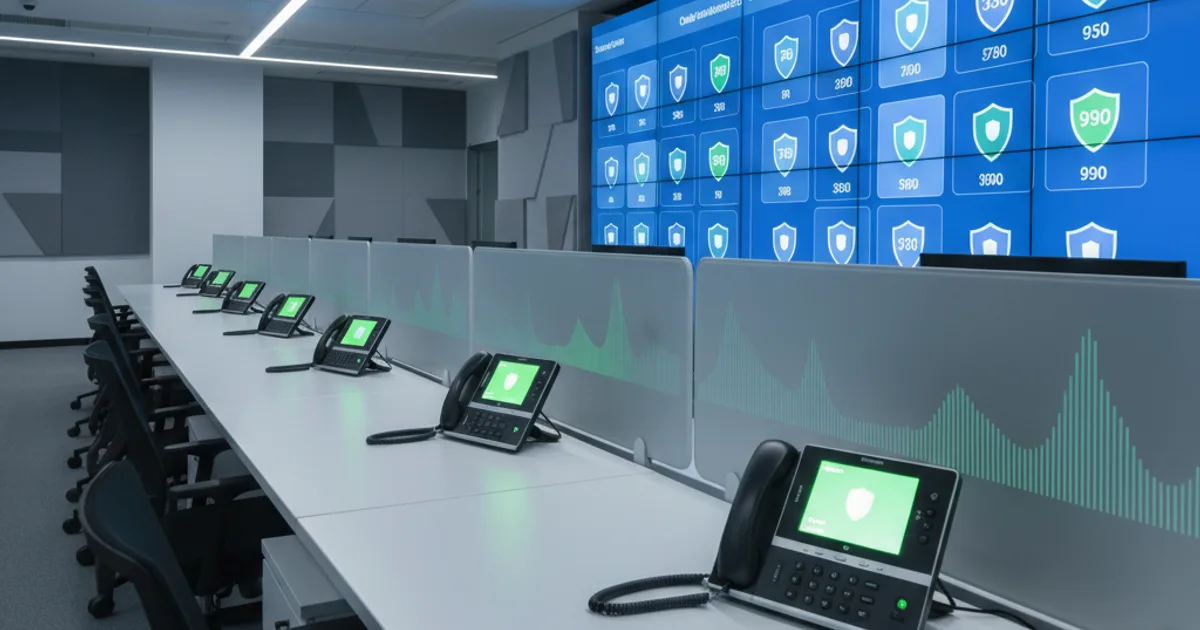
Caller ID reputation management under STIR and SHAKEN protocols is the operational discipline of ensuring outbound business calls authenticate correctly, carry strong attestation, and avoid spam or scam labels applied by carrier analytics vendors. According to the 2026 TNS Robocall Report, 85% of voice traffic between Tier-1 carriers is now authenticated, meaning an unflagged, well-attested number is a competitive asset every enterprise outbound team must actively protect.
What is the STIR/SHAKEN compliance framework for enterprise outbound voice?
STIR/SHAKEN is the FCC-mandated call authentication framework enacted under the TRACED Act that digitally signs outbound calls so receiving carriers can verify that the caller ID presented matches the originating provider's records. As of the first half of 2025, 84% of call traffic between top U.S. carriers including Verizon, AT&T, T-Mobile, and Comcast was signed and verified using STIR/SHAKEN, according to the iconectiv STIR/SHAKEN ecosystem data cited by multiple industry sources.
STIR handles the technical side: a digital certificate is attached to each outbound call's SIP header, cryptographically binding the caller ID to the originating provider. SHAKEN is the governance layer that defines how service providers obtain and manage those certificates. To participate, a provider must secure a Service Provider Code token and register with the SHAKEN Governance Authority. The TRACED Act, as analyzed by Mutare, gave the FCC authority to mandate this framework across the U.S. voice ecosystem.
For enterprise teams, the practical implication is straightforward. Your telephony provider must be registered and issuing signed calls. If your calls leave your provider unsigned, receiving carriers treat them with the lowest trust tier by default, which feeds directly into the analytics engines that apply Scam Likely labels.
Why do analytics vendors flag legitimate business calls as Scam Likely?
Carrier analytics vendors including Hiya Inc., TNS, and First Orion calculate real-time reputation scores on a 0-to-100 risk scale for every number making outbound calls, where 0 is lowest risk and 100 is highest. A number exceeding behavioral thresholds or receiving consumer complaint signals crosses a score threshold that triggers automatic flagging, regardless of the caller's intent.
The behavioral signals these algorithms watch are mechanical, not intent-based. High call velocity on a single number is the most common trigger. Low answer rates signal to the algorithm that the called parties are rejecting the calls, which itself raises the risk score. Poor area-code matching, where a business dials into a geography with no logical connection to its registered location, adds further risk. Low or absent STIR/SHAKEN attestation is a compounding factor. As the Lineshield analysis of Scam Likely labeling describes, this is a "numbers game played by algorithms," not a human review of call content.
When carriers apply a spam or scam label, the operational damage is severe. Answer rates drop by 30% to 60%, according to data cited by calleridreputation.com and corroborated across multiple industry sources. For a campaign running at a 20% baseline contact rate, a single spam flag can drop performance to single digits overnight.
How does STIR/SHAKEN attestation level directly impact call delivery rates?
Level A attestation, called Full Attestation, means the originating carrier has verified both the caller's identity and their right to use the specific number being dialed. It produces the highest trust signal in the analytics ecosystem and is the strongest available protection against automated spam scoring. Calls without Level A attestation are scored at lower trust tiers and are more vulnerable to flagging.
There are three attestation tiers. Level A confirms identity and number ownership. Level B, Partial Attestation, confirms identity but not that the caller is authorized to use that specific number, common in multi-tenant or hosted environments. Level C, Gateway Attestation, confirms only the call's entry point into the IP network, offering minimal trust value. The Federal Register ruling published August 19, 2025 (document 2025-15809) clarified that while businesses may use third parties for the technical signing, the business itself must make the attestation decisions and sign with its own certificate. This shifts compliance accountability squarely onto the enterprise, not the telephony vendor.
The practical consequence: enterprises running campaigns through shared or resold SIP trunks often receive Level B or C attestation by default. Auditing your provider's attestation output is a prerequisite step before running any high-volume outbound campaign.
What daily call volume thresholds trigger automated spam flags?
Analytics algorithms are highly likely to flag any number exceeding 100 outbound calls per day, and a flag is nearly certain above 200 calls per day on a single number. The safe operating band for sustained outbound campaigns is 50 to 80 calls per number per day, a threshold cited by multiple carrier and compliance sources including Aloware and Nextiva.
This constraint has a direct implication for campaign architecture. A team making 2,000 calls per day cannot concentrate that volume on 10 numbers. At 200 calls each, every number in that pool will be flagged within days. The correct architecture spreads volume across a larger DID pool, rotates numbers before they approach the 80-call threshold, and retires any number that accumulates consumer complaint signals. Automated reputation monitoring platforms can detect flagging and clear false labels in 2 to 3 days according to industry data, but prevention is operationally cheaper than remediation.
| Daily Call Volume per Number | Flag Risk Level | Recommended Action |
|---|---|---|
| Under 50 | Low | Standard monitoring |
| 50 to 80 | Moderate | Active monitoring, register with all three vendors |
| 81 to 100 | Elevated | Reduce volume, rotate DID pool |
| 101 to 200 | High | Flag likely; pause and remediate |
| Over 200 | Near-certain flag | Stop, remediate, replace number |
How do businesses implement branded calling and CNAM registry across major networks?
Branded calling, meaning your company name appears correctly on the called party's handset, requires registering with each of the three major analytics vendors: Hiya Inc., TNS, and First Orion. These vendors operate independently, so registration with one does not propagate to the others. CNAM (Caller Name) database registration is a separate step handled through your telephony provider, but CNAM alone does not control what mobile carriers display.
First Orion's AFFIRM Reputation Monitoring product and TNS's number reputation services both offer active monitoring alongside the display name registration. Verizon's Reputation Defense service, documented in their enterprise flyer, provides an additional layer for numbers with established Verizon traffic patterns. The sequencing matters: register display names first, then configure monitoring so you receive alerts before a flag reaches consumers rather than after answer rates have already dropped.
For enterprises with large DID pools, this process is operationally intensive. Agxntsix's Voice AI infrastructure manages DID pool hygiene, vendor registration, and attestation auditing as part of campaign deployment, treating caller ID reputation as an infrastructure variable rather than a one-time setup task.
What operational best practices prevent outbound call reputation decay?
Reputation decay happens gradually through accumulated behavioral signals, and it accelerates when remediation is reactive rather than proactive. The operational practices that prevent it address call patterns, DID management, consent hygiene, and attestation continuity.
CallTools and Convoso both document the core discipline: match area codes to the geography you are dialing, keep per-number daily volume below 80 calls, and purge numbers that show elevated complaint signals before they cross the flagging threshold. Consent hygiene matters as much as call mechanics. Numbers dialed without valid consent generate higher reject and block signals, which feeds directly into the risk score calculation. On fresh, consented outbound lists with high-reputation DIDs, a realistic baseline contact rate is 15% to 25%, per industry benchmarks from Convoso and Ansafone. Degraded lists or flagged numbers push that figure well below 10%.
A structured remediation protocol matters too. When a number is flagged, the correct sequence is: stop dialing on that number, submit dispute requests to Hiya, TNS, and First Orion simultaneously, and allow 2 to 3 days for clearance. Do not continue dialing a flagged number while the dispute is pending; additional call volume during remediation resets the algorithm's observation window and extends the flag.
| Practice | Why It Matters | Target Threshold |
|---|---|---|
| Per-number daily volume cap | Prevents velocity-based flagging | 50 to 80 calls/day |
| Level A attestation | Highest trust tier with analytics engines | 100% of outbound calls |
| Vendor registration (Hiya, TNS, First Orion) | Controls display name on mobile handsets | All three, independently |
| Area-code matching | Reduces geographic mismatch risk score | Match to dialed region |
| Consent-based list hygiene | Lowers consumer rejection signals | Only dial with valid consent |
| Proactive monitoring | Detects flags before answer rates fall | Daily automated checks |
Agxntsix structures enterprise Voice AI deployments around these controls from day one. The 60-day ROI commitment the company offers as a brand position reflects the operational specificity of this kind of infrastructure work: reputation management, attestation auditing, and DID rotation are not optional configuration steps but the foundation on which outbound performance is built.
Sources
- STIR/SHAKEN: What businesses need to know - Quo
- Why Your Outbound Calls Show SCAM LIKELY and How to Fix It
- STIR/SHAKEN Explained: Why Your Business Calls Are ... - Sangoma
- Protecting Your Outbound Calls from Receiving Spam Labels
- How to Achieve STIR/SHAKEN Call Compliance - CallTools
- How to Improve Your Caller ID Reputation Score for Outbound Sales
- STIR/SHAKEN Explained: Guide to Call Authentication & Enterprise ...
- How to Fix “Scam Likely” / “Spam Likely” Calls (2026) - Aloware