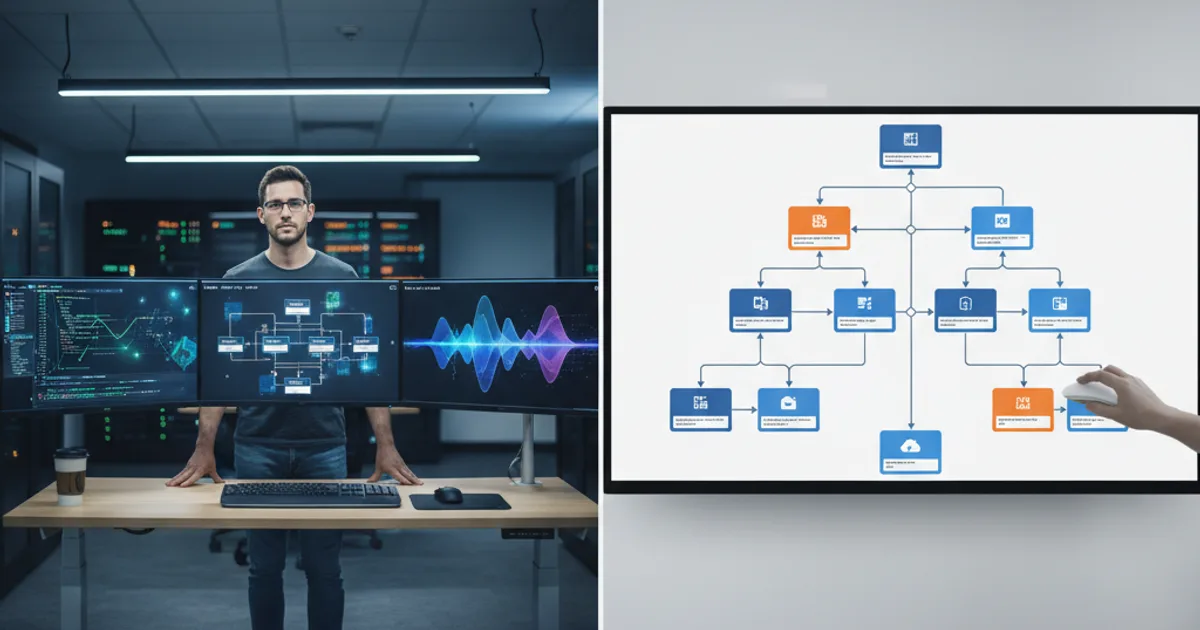
API-driven voice orchestration and drag-and-drop call builders both automate phone interactions, but they solve fundamentally different problems. The choice between them determines whether your voice AI can handle a real conversation or only a scripted one.
How does the latency of API-driven voice orchestration compare to drag-and-drop builders?
API-driven voice orchestration delivers a typical response latency of 536 milliseconds, comfortably below the sub-1-second threshold required for natural conversational flow. Drag-and-drop builders do not publish comparable latency benchmarks because their fixed-intent routing adds pattern-matching overhead before any speech synthesis begins.
The practical gap matters more than the number. An API-first system like Vapi assembles its own speech-to-text, LLM reasoning, and text-to-speech components independently, so each layer can be tuned or swapped without rebuilding the pipeline. A drag-and-drop tool bundles those layers into a proprietary stack optimized for simplicity, not low-latency throughput. Under load, that architecture trades response speed for ease of configuration. For enterprise calls where a caller is mid-sentence and expects a human-like reply, 536ms versus 800ms-plus is the difference between an interaction that feels natural and one that feels like a phone tree.
What are the operational cost differences between API voice agents and human agents?
AI voice calls cost approximately $0.07 per minute, compared to human agent costs of $28 to $40 per hour. Full end-to-end API-driven orchestration runs to roughly $0.12 per minute when all infrastructure costs are included, according to Vapi's published pricing.
The unit economics reshape the entire staffing model. A business running collections on a full human team pays $28 to $40 per hour per agent. The same volume routed through an API-driven platform can bring operational call costs down from $7 to $12 per human interaction to $0.40 per AI interaction, per Peakflo's analysis. API-driven orchestration reduces collection costs by 69% to 75% compared to a full collections team. Drag-and-drop platforms start lower on paper, with entry pricing at $29 per month, but their per-minute rates of $0.13 to $0.14 (Retell, Synthflow) exceed API-first platforms at scale. The upfront investment for API-driven voice orchestration also runs 67% to 80% lower than traditional IVR setups, and deployment typically completes in two to four weeks.
| Feature | Agxntsix (API-Driven) | Drag-and-Drop Builder |
|---|---|---|
| Response latency | ~536ms, sub-1s threshold | Not published; pattern-matching adds overhead |
| Cost per minute | ~$0.12 all-in | $0.13, $0.14 (Retell, Synthflow) |
| Setup time | 2, 4 weeks to production | Hours for simple flows; steep learning curve for complex branching |
| Intent handling | LLM reasons about caller goals, multi-turn context | Static phrase-to-action mapping; fails or escalates off-path callers |
| Data sovereignty | Self-hosted or on-premise options (HIPAA, GDPR) | Vendor-controlled infrastructure; limited sovereignty |
| Accuracy (context layer) | 90%+ with semantic grounding | 10, 20% raw schema; 6% raw LLM enterprise schema |
| Languages | 25+ with context retention | Typically limited to primary market languages |
Why does semantic grounding determine accuracy in enterprise voice systems?
Custom layered context architectures using semantic grounding achieve 90% or greater conversational accuracy, while raw database schema approaches achieve only 10% to 20%, and raw LLM enterprise schema approaches reach 6%, according to research from Promethium AI. Semantic grounding anchors the model's reasoning to structured, verified data before it generates a response.
Without it, the LLM is reasoning over ambiguous schema labels, abbreviations, and legacy field names that were never designed to be read by a model. A federated data architecture that maps those fields into LLM-readable context reduces hallucinations by giving the model concrete grounding for every claim it makes in a call. For a healthcare group routing appointment inquiries, a financial services firm handling payment negotiations, or a legal intake team qualifying leads, a hallucinated response is not just a bad experience; it is a liability. Agxntsix builds this semantic layer as part of its AI Infrastructure practice, connecting voice agents to the CRM and data systems they actually need to answer accurately. This connects directly to building a unified, LLM-readable data layer that supports real task completion across complex pipelines.
When should an enterprise move from a drag-and-drop builder to a custom voice AI API?
An enterprise should move to API-driven orchestration when its call flows require multi-turn context retention, real-time CRM writes, or task completion across more than three conditional branches. Drag-and-drop builders handle linear scripted flows well; they fail systematically on off-path conversations that require dynamic reasoning.
The signal is usually a rising escalation rate. When a meaningful share of automated calls reach a human agent not because the caller wants one, but because the bot could not recover from an unexpected response, the builder has hit its ceiling. Traditional IVR systems trigger customer frustration in 61% of users, and conversational AI solutions reduce call abandonment rates by 30% to 40% compared to legacy touch-tone menus, per BookedSolid. A drag-and-drop tool built on static phrase-to-action mapping is architecturally the same as an IVR tree; only the configuration interface is different. API-first platforms like Vapi and Dograh support self-hosted or on-premise deployments, which is often the deciding requirement for regulated industries operating under HIPAA or GDPR. The practical threshold: if your use case involves booking, rescheduling, payment negotiation, or multi-step qualification, an API-driven architecture is the right starting point, not an upgrade path.
What does a 35% DSO reduction actually mean for mid-market cash flow?
API-driven payment negotiation platforms achieve 25% to 35% payment promise rates versus 12% to 15% for traditional IVR systems, and implementing AI voice agents can reduce Days Sales Outstanding by 25% to 35%. For a business with $10 million in annual revenue, a 30-day DSO reduction improves cash flow by approximately $822,000.
That figure is not a projection; it follows directly from the mechanics of receivables. Shorter DSO means money already earned arrives faster, improving liquidity without adding revenue. A collections team running AI-driven outbound at scale, with 25% to 35% payment promise rates on calls that cost $0.40 per interaction rather than $7 to $12, transforms collections from a cost center into a cash flow lever. Commissioned Forrester research found that deployment of AI voice agents achieved a 391% return on investment. For a mid-market operator in financial services, healthcare billing, or B2B services, these are the numbers that determine whether AI voice pays for itself in one quarter or two, not whether it pays for itself at all. Agxntsix's 60-day ROI commitment is built around exactly this class of use case.
How do data governance and compliance requirements differ between modern voice platforms?
API-first platforms support self-hosted or on-premise deployments that keep call recordings, transcripts, and PII within an enterprise's own infrastructure, satisfying HIPAA and GDPR data sovereignty requirements. Drag-and-drop builders process and store data on vendor-managed cloud infrastructure, giving enterprises limited control over residency or retention.
For regulated industries, this is not a feature preference; it is a procurement gate. A dental group routing after-hours calls through a voice AI cannot accept a vendor that stores protected health information on shared cloud infrastructure without a signed Business Associate Agreement and documented data handling controls. A financial services operator handling payment negotiation must maintain complete audit trails for governance and logging to satisfy examination requirements. Production-grade conversational analytics systems address this through full audit trail retention, which is table stakes for enterprise deployment. Drag-and-drop tools designed for SMB simplicity rarely offer the granular logging, data residency controls, or BAA coverage that regulated enterprises need. Understanding these compliance requirements before choosing a platform is as important as evaluating call quality or cost. The compliance requirements for AI-driven outbound calling cover the TCPA, DNC, and consent framework in more detail.
How do API-driven and drag-and-drop platforms compare on complex pipeline tasks?
API-driven orchestration connects speech-to-text, large language models, and text-to-speech as independent, configurable components, enabling end-to-end task completion: booking, rescheduling, payment negotiation, and multi-step qualification. Drag-and-drop builders map static spoken phrases to a fixed action list and escalate any call that does not match a defined intent.
The architectural difference is not cosmetic. When a caller on a payment negotiation call says "I can pay half now and the rest on Friday," an API-driven system with LLM reasoning can evaluate that offer against policy, confirm it, and write the arrangement to the CRM. A drag-and-drop builder with fixed intents will either mis-classify the response or route to a human because no matching phrase was scripted. AI voice agents successfully handle 60% to 80% of routine inbound calls including FAQs and status updates; for those use cases, a drag-and-drop tool may be sufficient. Complex pipelines that require memory across turns, real-time data reads, or conditional task execution need the composability that only an API-first architecture provides. Operational adoption that sticks follows three phases: foundation building, pilot deployment on a contained call type, then scale progression across the full pipeline. Rushing past the pilot phase is the most common reason enterprise voice AI deployments underperform. Review how Agxntsix structures AI infrastructure deployments for the full three-phase framework.
Sources
- AI Voice Agents vs Traditional IVR for AR Collections - Peakflo
- Conversational AI Market Report 2025 - MarketsandMarkets
- IVR vs AI Voice Agents: What's Best for Modern Clinics? - BookedSolid
- Vapi - Build Advanced Voice AI Agents
- 12 Best Conversational AI Platforms for 2026 - Retell AI
- 9 Best Voice AI APIs for Outbound & Inbound Calling - Dograh
- Conversational Analytics: How AI Agents Transform Data Access in Enterprise